


Water in the Electrical Panel After Heavy Rain in Merritt Island: What Should You Do First?
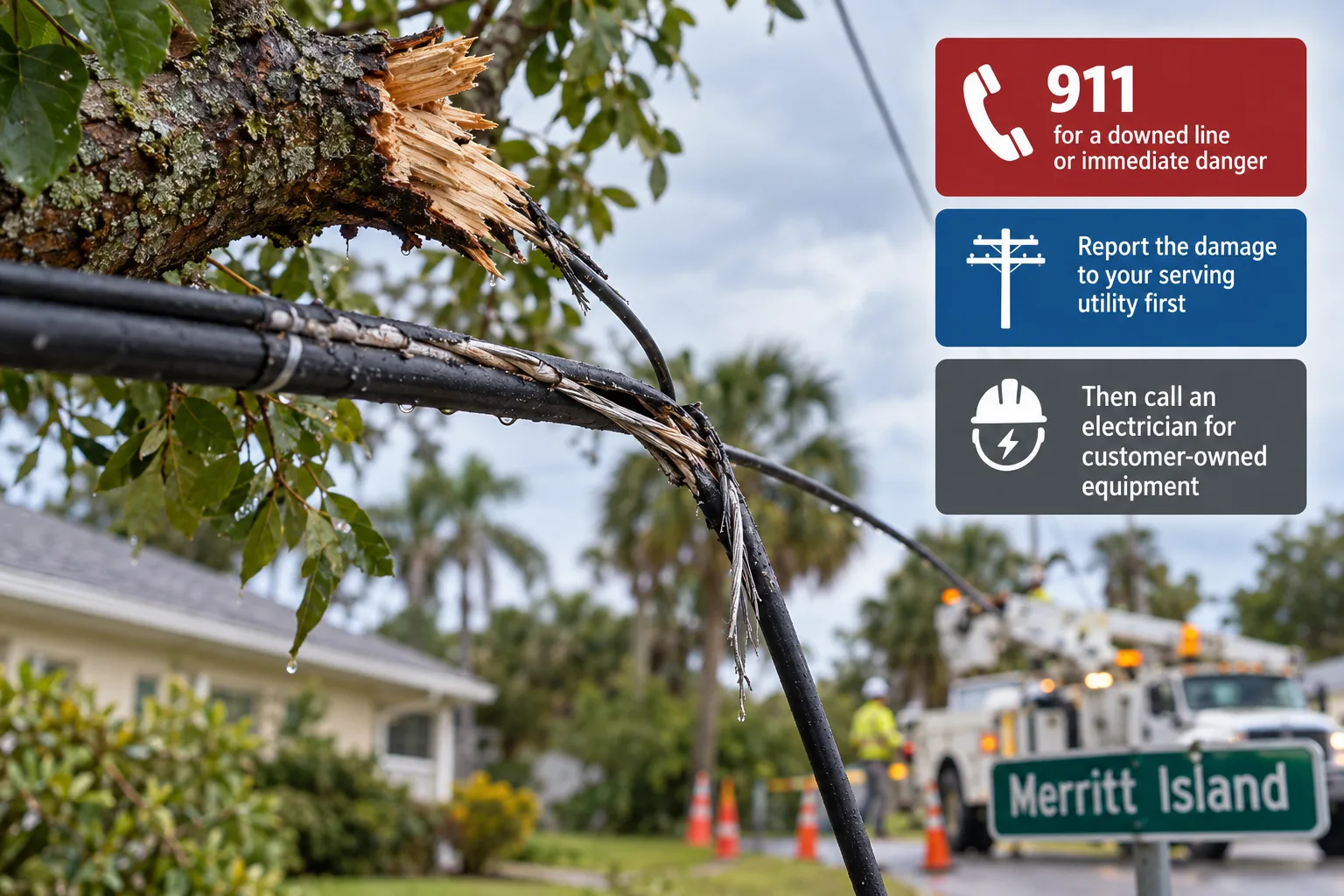
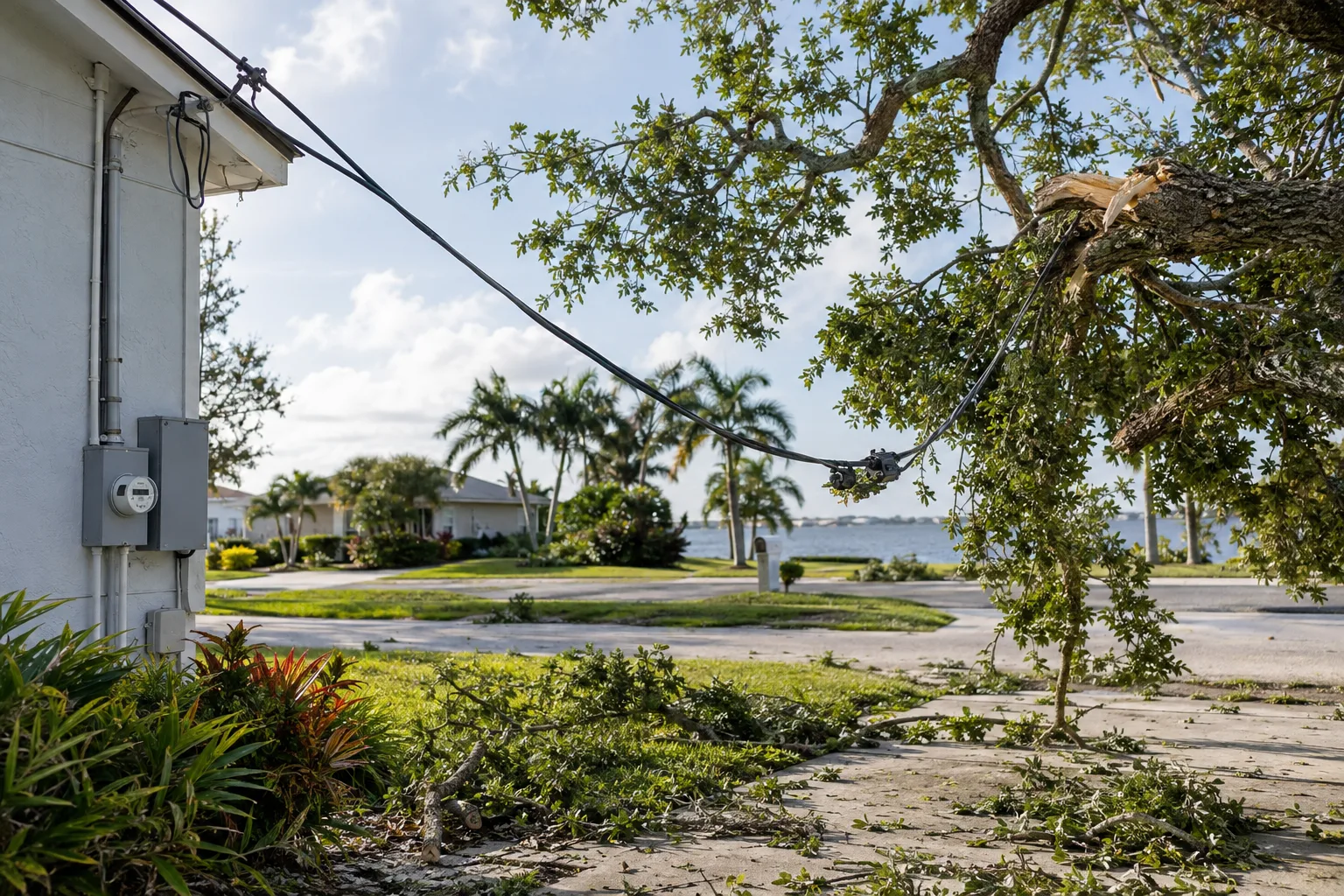
Stay away from the wet panel and any fallen, sagging, or tree-damaged electrical line. Call 911 for a downed line or immediate danger, and report damaged service wires to the property’s serving utility before anyone attempts repairs. Do not open the panel, touch the meter enclosure, or try to turn off a main breaker located in wet or damaged equipment.
Water appearing at an electrical panel after a Merritt Island storm may involve a roof leak, damaged service entrance, or another moisture path. If a tree branch pulled down a service line, the same force may have damaged the equipment that normally keeps rain out. The first priority is safe isolation—not finding the leak yourself. An electrician’s diagnosis and repair come after the utility-controlled hazard has been addressed.
Who to Call First: Emergency Responders, the Utility, Then an Electrician
A dark house does not prove its electrical service is safe. A fallen conductor can remain energized without sparks, and power can return unexpectedly. Water around electrical equipment adds another possible path for current, including through nearby metal and wet surfaces.
Florida Power & Light’s electrical safety guidance instructs people to stay away from downed power lines and report dangerous conditions. FPL advises keeping at least 30 feet away from downed lines and anything they contact. Treat that as a minimum, not a reason to approach: keep farther away when there is water, uncertain wire placement, or an emergency responder’s restricted area. Follow the serving utility’s current instructions for the actual location.
Call 911 for a downed line or immediate danger
Call 911 from a safe location if a line is down, someone has been shocked, equipment is burning, or there is another immediate threat. Report whether a wire is on a building, vehicle, fence, tree, walkway, or road. Do not approach to determine whether it is an electrical wire or a communications cable.
If smoke, arcing, or a burning smell is coming from the panel, move away and contact emergency responders. Leave the affected area by a safe route that does not cross standing water, damaged wires, or equipment. Do not attempt to fight an electrical fire with water.
Report service damage to the serving utility
Report a fallen or sagging service line, tree contact, or visibly damaged service connection to the utility as a hazard—not just as an ordinary outage. Explain if water is also visible at the panel or meter equipment. A routine outage report may not communicate that a wire is lying across a driveway or that the mast has pulled away from the house.
Confirm the utility using the property’s bill, account records, or property manager rather than assuming every reader has the same provider. If FPL serves the address, use its official website for current outage and hazard-reporting options. For immediate danger, do not rely only on an online outage submission.
Arrange electrical diagnosis after the hazard is reported
The utility handles hazards and switching involving its distribution system and service conductors. An electrical contractor evaluates and repairs equipment that falls under the property owner’s responsibility. Those are separate jobs, even when both are necessary to restore the same building.
If water is visible at the panel but no fallen line or immediate danger is apparent, keep away from the equipment and arrange professional electrical assessment promptly. Explain the moisture condition before the visit. The contractor may need to coordinate utility isolation before inspecting or working on service equipment.
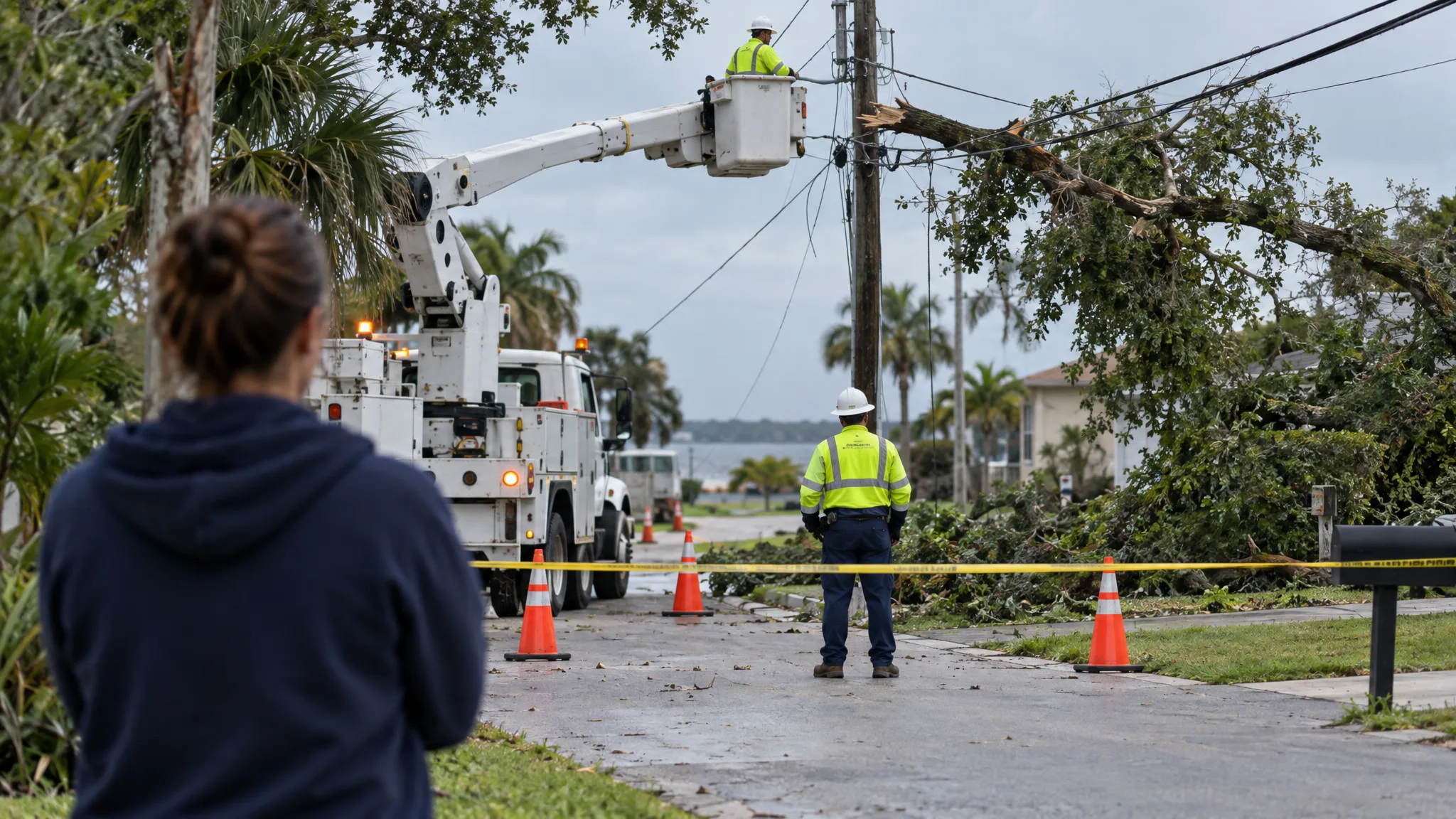
Do not wait for sparks, repeated breaker trips, or a burning smell to take water intrusion seriously. Scheduling a diagnostic visit does not make equipment safe to touch or authorize anyone to enter a restricted area.
What Not to Touch or Attempt Around a Fallen Service Line
After heavy rain, a branch, fence, pool enclosure, gutter, or puddle may be part of an electrical hazard if it contacts an energized conductor. Keep occupants, pets, delivery drivers, maintenance workers, and landscape crews away. Warn others verbally from a safe location rather than walking toward the line to set up a barrier.
- Do not move or lift a wire. Do not use a broom, ladder, rope, tool, or other object to test or reposition it.
- Do not remove the branch. Tree material touching electrical equipment requires utility-controlled hazard assessment before cleanup can proceed.
- Do not touch a leaning mast, displaced meter enclosure, or loose service attachment. Metal parts may be energized even when indoor lights are off.
- Do not open a wet panel. Removing the cover can expose energized parts and place you directly in the hazard area.
- Do not reset breakers to test the system. Restoring power to wet or damaged equipment can create another fault.
- Do not dry electrical equipment with a fan, hair dryer, heat gun, or improvised heater. Surface dryness does not establish electrical safety.
- Do not apply caulk, tape, or a tarp to damaged service equipment. Finding and sealing the entry point is professional work once the area is safe.
- Do not connect a generator through a household outlet. Improper connections can backfeed wiring and endanger utility workers, neighbors, and occupants.
Why turning off the main breaker may not be safe
People often assume the first step is to flip the main breaker. That is not appropriate when reaching it requires approaching a wet panel, damaged service equipment, standing water, or a fallen line. Even with a main breaker off, incoming service components can remain energized.
Solar generation, batteries, and generators can introduce additional sources of power. Tell the utility and electrician about them. Do not assume operating one switch isolates every electrical source at the property.
The Electrical Safety Foundation International provides storm and flood electrical safety guidance emphasizing professional evaluation of water-damaged equipment before it is returned to use. A panel that looks dry the next morning may still contain corrosion, contamination, or compromised components.
Service Drop, Weatherhead, Mast, and Meter Equipment: Who Repairs What?
Understanding a few components makes the reporting and repair conversations easier. The service drop is the overhead wiring extending from the utility system toward the building. The weatherhead is the fitting at the top of a service entrance that helps limit rain entry. The mast is the conduit that carries service wiring and, in some installations, supports the overhead connection.
The meter enclosure, sometimes called the meter socket or meter can, houses the utility meter. These parts work together, but they do not necessarily have the same owner or repair provider.
The table below describes common arrangements, not a definitive ownership determination. The serving utility’s current service standards, the approved connection point, and the property’s actual configuration control. Condo buildings, grouped meters, older installations, and commercial services may differ.
| Equipment or condition | Who commonly handles it | What the property owner should confirm |
|---|---|---|
| Utility pole, transformer, and overhead service-drop conductors | The utility generally controls work on its equipment and conductors. | The exact point where utility ownership and customer responsibility meet. |
| Tree or branch contacting a service line | The utility must assess the electrical hazard and determine safe isolation or clearance needs. | Who will perform vegetation removal after the utility establishes safe conditions, and who bears that cost. |
| Service attachment on the building | Often a property-owner responsibility repaired by an electrical contractor, sometimes with structural repair support. | Utility attachment requirements and whether the wall, fascia, or roof structure is damaged. |
| Weatherhead, service mast, and associated supports | Commonly customer-owned equipment requiring electrician repair. | The required repair configuration under utility standards and applicable electrical requirements. |
| Service-entrance conductors on the customer side of the connection | Commonly repaired by an electrical contractor after appropriate isolation. | The ownership boundary, conductor condition, and utility coordination requirements. |
| Utility meter | The utility generally controls the meter and its removal or reinstallation. | The utility’s procedures; occupants and maintenance staff should not remove it. |
| Meter socket or enclosure | Often customer-owned, even though the utility owns the meter inside it. | Whether it belongs to an individual owner or a building association, and whether replacement requires utility approval. |
| Main disconnect, electrical panel, and downstream wiring | Usually property-owner equipment assessed and repaired by an electrical contractor. | Water exposure, repair scope, permit requirements, and any shared-building responsibilities. |
A utility crew reconnecting its wire does not automatically mean every customer-owned component has been evaluated for water intrusion. Likewise, an electrician cannot simply reconnect utility-owned wires or bypass a utility hold. Ask each provider what equipment was addressed and what work remains.
When Tree Damage Requires an Electrician in Merritt Island
If a tree branch pulled down a service line, the visible wire is only part of the problem. Tension on the connection can bend a mast, loosen an attachment, shift conduit, damage a weatherhead, or pull a meter enclosure away from the wall. Some damage may be hard to see without a controlled inspection.
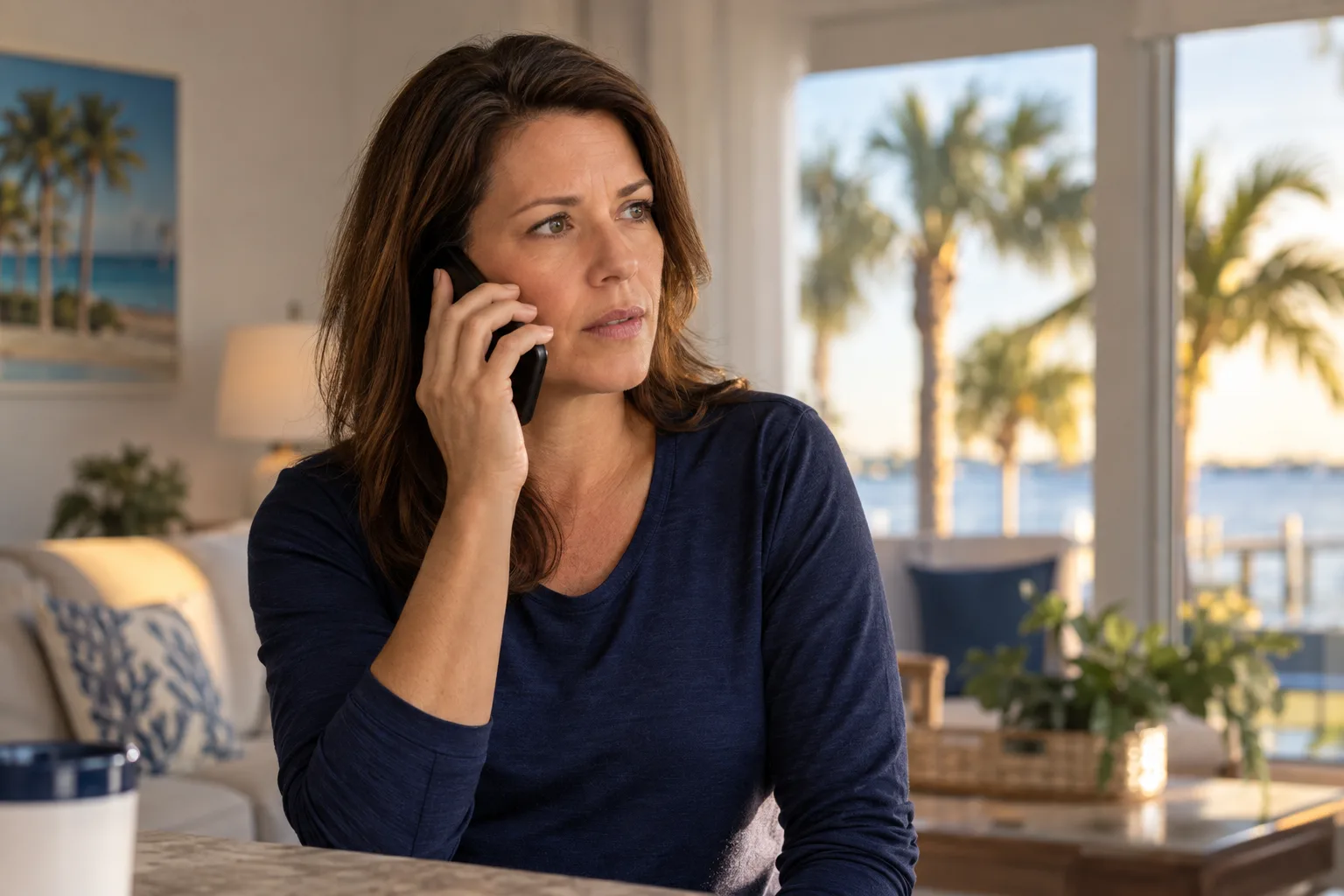
For an electrician in Merritt Island, the diagnostic question is not simply, “Can power be turned back on?” It is, “What was stressed, what became wet, and what must be repaired before this installation can safely operate?”
Warning signs to report without approaching
Tell the contractor about conditions you have already noticed from a safe location. Do not make a special trip toward the equipment to look for them.
- A service mast that appears bent or no longer upright.
- A weatherhead that appears displaced or broken.
- A meter enclosure or conduit separating from the building.
- Water streaks, dripping, or rust staining at the panel enclosure.
- New damage at the roof penetration or service attachment.
- Buzzing, crackling, unusual odors, or smoke.
- Partial power, unusual brightening and dimming, or loss of some circuits after the storm.
- Breaker trips that started during or immediately after heavy rain.
Unusual brightening and dimming can indicate a serious service problem, including a compromised neutral connection. Report it promptly to the utility and electrician. Do not continue running equipment to see whether the condition clears.
How rain can reach a panel
A damaged weatherhead and service mast can allow water into parts of the service entrance that should be protected. Water may also enter around conduit fittings, a meter enclosure, a wall penetration, or a roof opening. An unrelated roof or plumbing leak can wet a panel from above.
These possibilities require different repairs. Replacing a wet breaker without correcting the moisture path leaves the underlying problem unresolved. Sealing a roof leak without evaluating exposed electrical components also leaves an important safety question unanswered.
In Merritt Island’s coastal environment, existing corrosion may complicate storm damage. The electrician should distinguish the immediate failure from older deterioration that affects repair safety. That does not mean every wet panel automatically requires a full service replacement; it means the decision needs evidence, applicable requirements, and manufacturer guidance.
What diagnosis should establish
Once safe isolation and access are available, the electrician can assess the service entrance, enclosures, supports, conductors, terminations, and visible water path. The assessment should identify which components can remain in service and which require replacement. Some water-exposed electrical devices are not suitable for reuse merely because they have dried.
If building damage is allowing water in, a roofer or other appropriate contractor may also be needed. That work must be coordinated so no one works near an unresolved electrical hazard.
What to Report From a Safe Location—and Who Should Coordinate for Rentals or Condos
Accurate information helps the utility and electrician understand the situation before arriving. It does not require close-up photographs or opening equipment. Describe only what you can already observe safely.
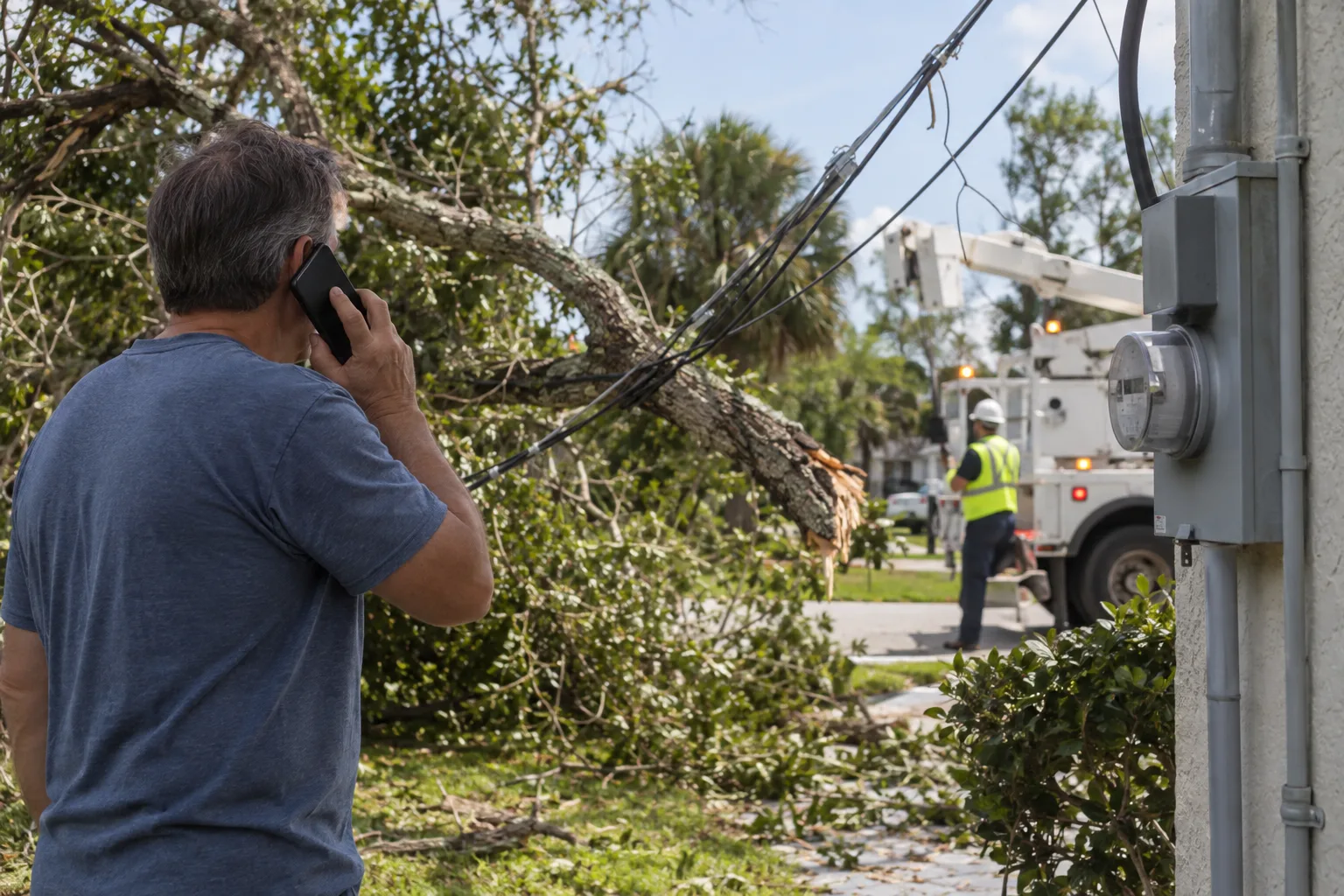
A useful reporting checklist
- Exact service address: Include unit, building, or suite numbers and whether multiple meters serve the property.
- Hazard location: Explain whether the line is near the driveway, backyard, public walkway, parking area, or shared entrance.
- Observed damage: State that a tree contacted the line, the mast appears displaced, or water is visible at the panel.
- Immediate danger: Report smoke, arcing, fire, injuries, or a line contacting a vehicle or building.
- Power condition: Say whether power is completely out, partly out, flickering, or still on.
- Water conditions: Mention standing water or wet access routes without entering them.
- Additional power sources: Identify solar panels, a battery system, or a generator installation.
- Access limitations: Explain blocked gates, fallen trees, locked common equipment rooms, or restricted parking.
- Existing reports: Keep the utility incident number and any responder instructions available.
If the property supports medically necessary equipment, communicate that need to emergency responders and the utility. Arrange a safe alternative location or other assistance as appropriate; a medical need does not make an uncertain restoration time reliable.
Rental properties: separate reporting from repair authorization
A tenant should not wait for a landlord’s response before reporting a downed line or immediate danger. After the emergency report, the tenant should notify the owner or manager. The owner or authorized manager can then coordinate repair authorization, access, utility communications, and occupant updates.
Maintenance staff should not be sent to open the panel, pull a meter, move branches, or test whether equipment is live. Their useful role is coordination from outside the hazard area: confirming the address, sharing prior service information, and arranging safe access after clearance.
Condos and small commercial properties: identify the equipment decision-maker
A condo’s damaged equipment may serve one unit, multiple units, or common areas. Notify the association or property manager early so the contractor can establish who controls the affected service equipment and who can authorize work. Ownership documents and the actual electrical layout may both matter.
For a small commercial building, identify the owner’s representative and any tenants affected by a service shutdown. Tell the electrician about refrigeration, security systems, access controls, and other operational concerns. These help plan the work, but they do not override isolation or inspection requirements.
Document the storm without creating another exposure
Save the time damage was discovered, outage messages, utility report numbers, and photographs taken from a safe location. Existing security-camera images may help document when a branch fell. Keep estimates, invoices, and written descriptions of damaged components for an insurance claim.
Do not delay an urgent safety response to collect claim evidence. Ask contractors to document inaccessible damage when they can safely inspect it. Never approach exposed equipment simply because an insurer requests a clearer photograph.
How Utility Isolation, Electrical Repairs, Inspection, and Reconnection Fit Together
Electrical service restoration after tree damage is a coordinated process, not a single repair appointment. A contractor may be ready while the utility has not yet isolated the service. Completed customer-equipment repairs may still require inspection and a release before reconnection.
- Emergency reporting and hazard control: Emergency responders and the utility address immediate danger and establish any necessary restricted area.
- Utility isolation: The utility handles the required disconnection or isolation of its system. Electrical workers also follow their safety procedures and account for other power sources.
- Customer-equipment diagnosis: The electrician evaluates damage and water exposure once safe access is available.
- Repair planning and approvals: The contractor confirms the scope, utility specifications, applicable permit process, and any building repairs needed.
- Electrical and related repairs: Damaged customer-owned equipment is repaired or replaced, and the moisture entry path is addressed.
- Required inspection and release: The applicable authority inspects the work when required and provides the required approval or release.
- Utility reconnection: The utility reconnects under its procedures after applicable requirements are satisfied.
- Post-restoration assessment: The electrician completes appropriate checks and explains any remaining limitations or follow-up work.
Confirm the permitting authority for the address
For many Merritt Island properties, Brevard County is the relevant building authority. Confirm the jurisdiction for the specific address rather than assuming a mailing address settles it. The county’s Building Permits resources provide an official starting point for permit and inspection information.
Service mast, meter enclosure, service-entrance, and panel work may trigger permit and inspection requirements. The contractor should confirm the applicable emergency-repair process with the authority having jurisdiction and the serving utility. “Emergency repair” should not be interpreted as permission to skip required approvals.
Keep temporary power separate from damaged equipment
If temporary power is needed, discuss a safe solution with the electrician. A generator is not a way to energize a wet panel or bypass a utility disconnection. Approved transfer equipment and proper isolation are essential where a generator connects to building wiring.
Portable generators must also be used outdoors, well away from doors, windows, and vents, following manufacturer and public-safety guidance. Never operate one in a garage or enclosed space. Temporary convenience must not introduce electrical backfeed or carbon monoxide hazards.
What Affects Repair Cost and Restoration Time?
A reliable estimate depends on the damaged equipment, not just the fact that a branch fell. Two neighboring properties can have different repair needs even after the same storm. One may need a service attachment repair; another may have water-damaged panel components, compromised conductors, and structural damage at the mast support.
Factors that change the repair scope
- Extent of mechanical damage: A loose support differs from a bent mast or damaged meter enclosure.
- Extent of water exposure: Moisture may affect more than the component where dripping was first noticed.
- Equipment condition and compatibility: Existing corrosion, obsolete components, and suitable replacement availability can affect the work.
- Required utility-standard corrections: The repaired arrangement must satisfy applicable connection requirements.
- Building repairs: Damaged roof decking, fascia, wall framing, or mounting surfaces may need attention before electrical equipment can be secured.
- Shared service arrangements: Grouped meters and common disconnects may require broader coordination.
- Permits and inspection: Requirements depend on the scope and jurisdiction.
- Safe access: Debris, flooding, unstable trees, and restricted areas can prevent work from beginning.
Ask the contractor to distinguish diagnosis, electrical repairs, permit-related items, and work by other trades. Also ask which parts of the estimate may change after isolation permits a closer inspection. A useful scope should explain both the immediate repair and how the rain-entry problem will be corrected.
Why nobody should promise restoration before the dependencies are known
Restoration depends on safe utility access, isolation, repair materials, customer-equipment work, required inspections, and utility reconnection. An electrician’s appointment time is not a utility restoration promise. Likewise, an area-wide outage estimate may not account for damage specific to your building.
Ask for status by stage: Has isolation occurred? Is the repair scope confirmed? Are repairs complete? Is inspection or a utility release still needed? These questions are more useful than treating the entire process as one uninterrupted task.
Who pays, and what might insurance cover?
Property owners are generally responsible for repairs to equipment they own, subject to the actual utility boundary, lease terms, association documents, and other applicable obligations. Customer responsibility for a meter enclosure can exist even when the meter itself belongs to the utility.
Insurance coverage depends on the policy, cause of damage, exclusions, deductible, and claim assessment. Ask the insurer about storm-related electrical damage, related building repairs, and documentation requirements. Neither the utility’s response nor an electrician’s diagnosis guarantees that a claim will be paid.
Common Questions About Wet Panels and Tree-Damaged Service Lines
Should I call 911 and the utility if the line is down but is not sparking?
Yes. A downed line can be energized without visible sparks or noise. Stay away, call 911, and report it to the serving utility from a safe location. Do not approach to identify the wire, test it, or see whether it moves. Keep away from objects and water it may contact as well.
If the utility reconnects its wire, do I still need an electrician to check the mast or weatherhead?
Yes, if there is suspected customer-equipment damage, water intrusion, displaced equipment, or unresolved electrical symptoms. Ask the utility what its work included. Reconnecting a service conductor is not necessarily a complete evaluation of the building’s mast, weatherhead, meter socket, panel, and downstream wiring.
Can I remove the branch or turn off the main breaker while waiting?
Do not remove a branch touching or near damaged electrical lines. Wait for utility hazard assessment and authorized clearance. Do not approach a wet or damaged panel to operate its breaker. Turning the main off also does not deenergize all incoming service components. Tell responders and the electrician about any solar, battery, or generator sources.
The rain stopped and the panel looks dry. Can I use it normally?
Visible dryness does not establish that internal electrical parts are safe. Water can leave contamination or cause deterioration that is not apparent from outside the enclosure. Do not open it or reset breakers as a test. Arrange qualified assessment and follow the instructions provided for keeping affected equipment out of service.
Will restoration require a permit or inspection in Merritt Island, and how long could it take?
It may. The answer depends on the service damage, repair scope, jurisdiction, and utility requirements. Have the contractor confirm the permit, inspection, and reconnection-release steps for the address. There is no responsible universal timeline: access, isolation, repairs, materials, approvals, and reconnection must each be resolved.
Will a whole-home surge protector solve water entering the panel?
No. Surge protection addresses certain transient overvoltage events; it does not waterproof a panel, repair a weatherhead, or make a fallen wire safe. Once the immediate damage is resolved, understanding how whole-home surge protection works can help with a separate protection discussion. It should not replace diagnosis of the moisture source.
What can owners do after repairs to prepare for another storm?
Ask the electrician whether the repaired service has any remaining concerns involving weather exposure, deteriorated enclosures, supports, or backup-power arrangements. Property managers can also review storm-season electrical upgrades for Space Coast rental properties when planning maintenance. Keep utility account information, owner authorization contacts, and safe-access instructions available before the next storm.
Schedule the Next Repair Conversation With Deltron Electric
Water at an electrical panel after heavy rain calls for diagnosis, not a reset-and-wait approach. If tree damage is involved, the utility must first address the fallen or damaged line and establish the isolation needed for customer-equipment work. Only then can the repair team safely determine whether the weatherhead, mast, meter enclosure, panel, or related wiring needs attention.
After reporting the hazard to the utility and emergency responders as appropriate, call Deltron Electric at (833) 335-8766 to discuss possible customer-owned service equipment damage and schedule a diagnostic service visit. Have the service address, utility report number, observed symptoms, and owner or association contact information ready. Access and repairs depend on safe utility isolation and site conditions.
You can also discuss electrical diagnostics and repair with Deltron Electric to clarify the next step for your Merritt Island property. The goal is to identify the damage, correct the water-entry path, and establish what must happen before the affected equipment can safely return to service.