


Can I Install or Replace a Ceiling Fan in My Cocoa Beach Condo Without Association Approval?
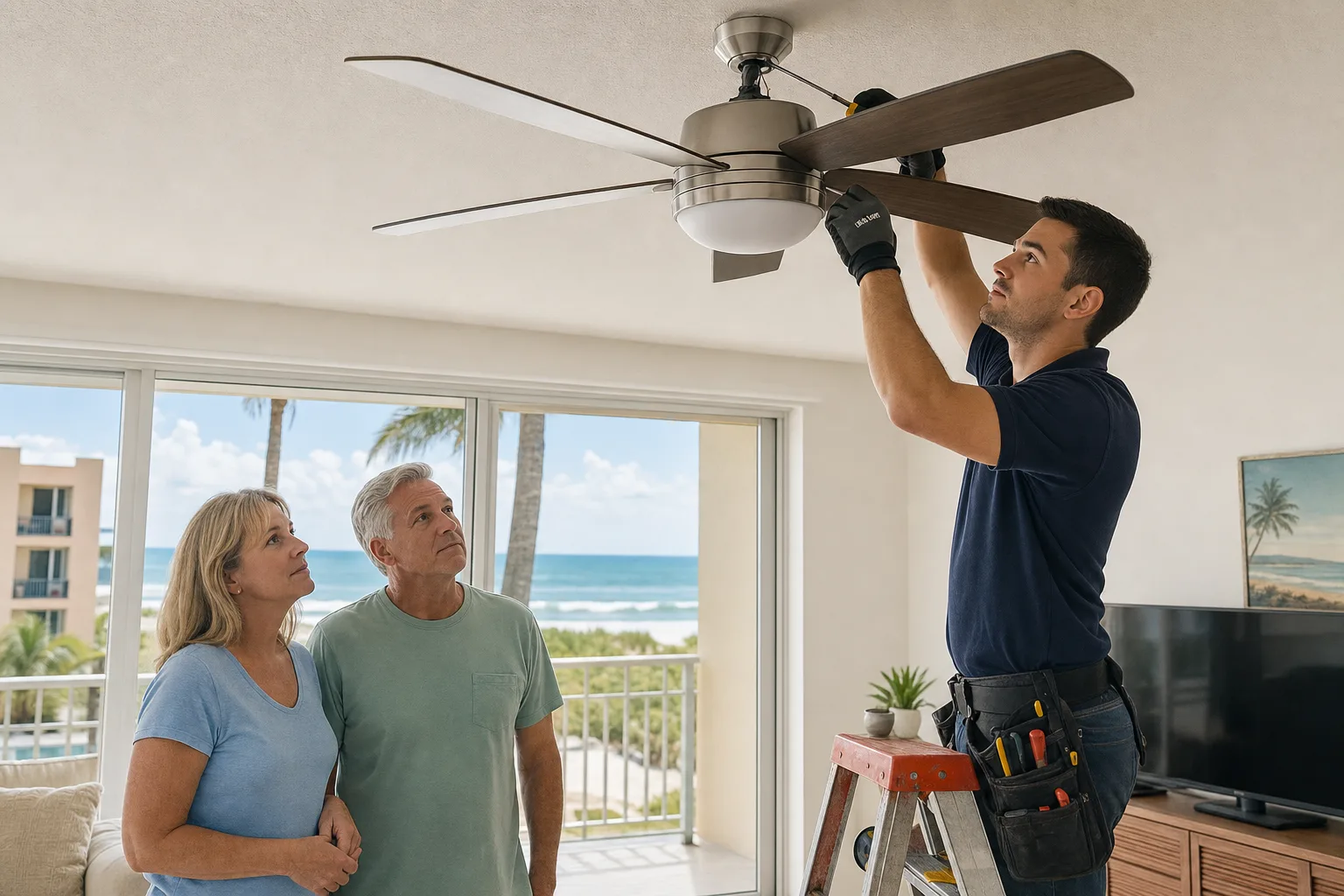
Installing a new ceiling fan or replacing an outdated one can make a Cocoa Beach condo more comfortable, especially during warm, humid months. But a project that appears simple can involve more than selecting a fan and connecting it to an existing ceiling light. Condo association rules, unit boundaries, electrical safety requirements, permit questions, and the condition of the existing ceiling box can all affect the right next step.
The safest practical answer is not to assume that an existing light fixture location is ready for a rotating ceiling fan or that interior work never needs association coordination. Review your condo documents, ask the manager or board about the community’s process, and have uncertain mounting hardware or wiring diagnosed before buying equipment or authorizing work.
Quick Answer: When Condo Association Approval May Be Needed
A ceiling fan may be an owner-responsibility improvement inside a condo unit, but that does not automatically mean it can be installed without notice, documentation, or prior association approval. Each Cocoa Beach condominium community has its own declaration, bylaws, rules, alteration procedures, and contractor-access requirements.
Association approval or coordination may be more likely when the project involves:
- Changing an existing light fixture into a ceiling fan location.
- Adding a new fan where no ceiling fixture currently exists.
- Running wiring through walls, ceilings, or shared building spaces.
- Adding a switch, changing a control location, or separating fan and light controls.
- Working near a common element, limited common element, fire-rated assembly, shared ceiling cavity, or building system.
- Scheduling contractors in a high-rise or managed building with work-hour, elevator, parking, insurance, or access rules.
- Installing a fan near a balcony, exterior door, lanai, or another area affected by moisture and coastal air.
Even a like-for-like fan replacement can require association coordination. Some communities require contractors to register with management, provide licensing or insurance information, reserve an elevator, observe limited work hours, or notify staff before entering the building. Seasonal residents, landlords, and property managers may also need to confirm who can provide unit access and approve decisions if an issue is discovered during the work.
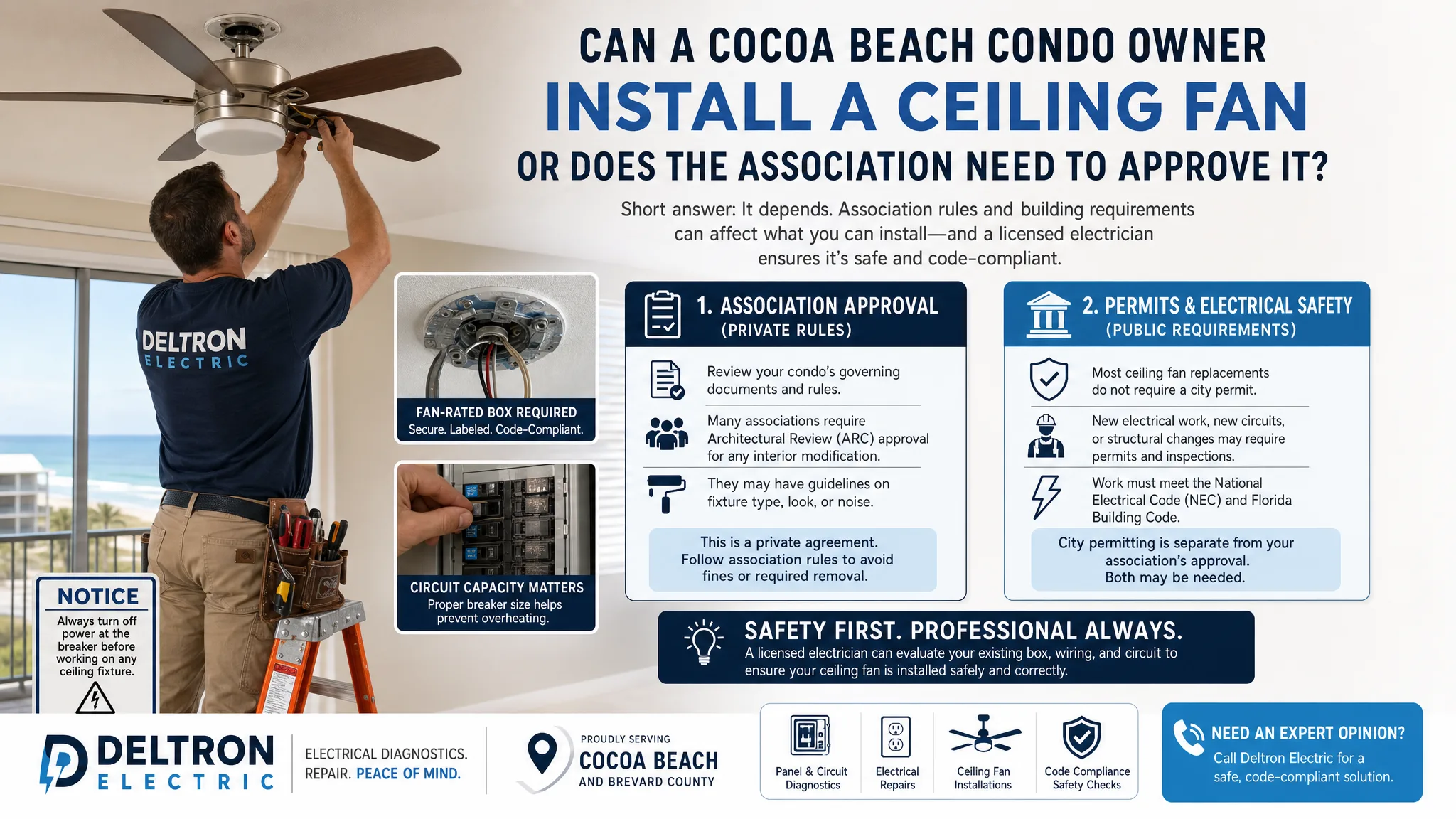
Most importantly, association authorization does not confirm that the electrical setup is safe. A fan must be mounted to a properly supported, fan-rated electrical box or other approved support arrangement and installed according to the manufacturer’s instructions. A ceiling box that was acceptable for a lightweight light fixture may not be suitable for the movement and weight of a ceiling fan.
Check the Declaration, Rules, and Architectural Review Process First
Before choosing a fan or scheduling installation, find the most current version of your condominium declaration, bylaws, rules, alteration policy, and architectural review materials. Florida condominium matters are addressed generally in Chapter 718 of the Florida Statutes, but state law is not a substitute for the documents and procedures that apply to your specific community.
Deltron Electric does not provide legal advice or interpret association documents for owners. Your property manager, board, association counsel, or other appropriate representative can explain how the community applies its own rules. Getting direction in writing can help prevent confusion after the work has been completed.
Questions to Ask the Condo Association or Property Manager
- Is this specific ceiling fan replacement or installation considered an alteration?
- Do I need written approval, an architectural review form, a work order, or advance notice?
- Does the association require proof of contractor licensing, insurance, permit information, or a certificate of insurance?
- Are there approved contractor work hours, parking instructions, elevator reservations, or check-in requirements?
- Does the proposed work affect a common element, limited common element, shared ceiling area, structural support, or building wiring?
- Are there special requirements for work in high-rise units, rentals, seasonal residences, balconies, or moisture-prone locations?
- Does the community have restrictions related to fixture appearance, exterior-adjacent locations, noise, or construction access?
Do not rely solely on a neighbor’s past project as proof that your project is permitted by the association. Rules can change, a neighbor’s scope may have been different, and older work may not have been approved or completed correctly. A written answer tied to your unit and proposed work is much more useful than an assumption.
Unit boundaries matter as well. The light fixture within a living room may be an owner-maintained item, while the concrete slab, ceiling cavity, structural support, shared wiring pathways, or building systems beyond the unit boundary may be handled differently under the condominium documents. The answer depends on the community’s governing documents and the actual conditions at the location.
Association Approval, City Permits, and Electrical Code Are Different Requirements
Condo owners often hear “approval” and assume the project is cleared. In reality, a ceiling fan project can involve three separate questions:
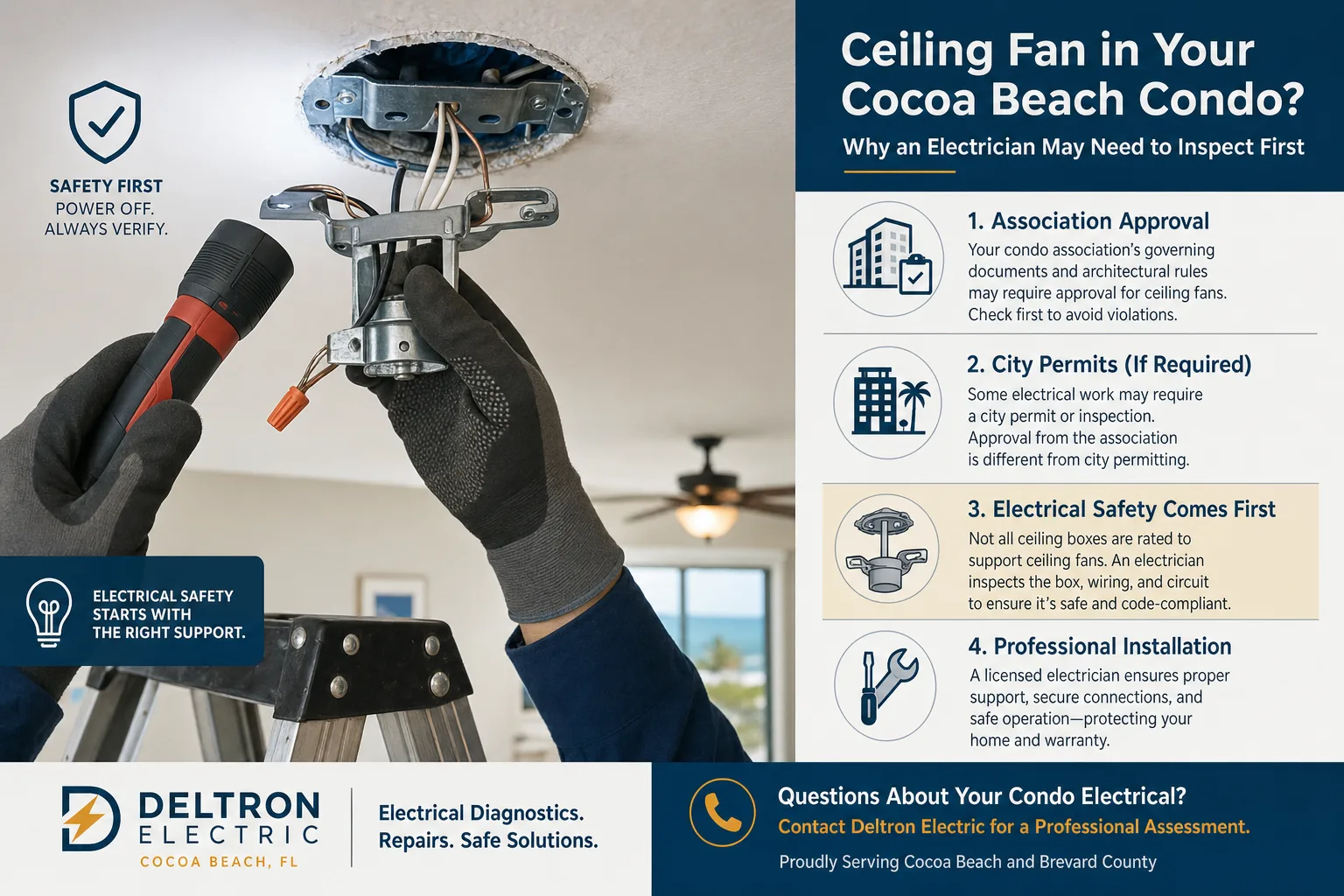
- Does the condo association authorize or require documentation for the alteration?
- Does the City of Cocoa Beach or another authority having jurisdiction require a permit or inspection for the electrical scope?
- Can the installation be completed safely and in accordance with applicable electrical requirements and manufacturer instructions?
These requirements can overlap, but one does not replace the others. An association may permit a project that still requires qualified electrical work, a permit, or an inspection. Similarly, a permit decision does not authorize an owner to bypass a condo association’s alteration process.
Permit requirements can depend on the actual scope. Replacing a fixture at an existing suitable location may be treated differently from installing a new ceiling outlet box, extending wiring, adding a branch circuit, relocating switches, modifying controls, or opening finished building assemblies. Because local requirements and interpretations can change, project-specific permit questions should be verified with the City of Cocoa Beach Building Department or the applicable authority before work begins.
A useful approach is to identify the electrical scope before submitting vague paperwork to the association. If the existing box is not fan-rated, the circuit has a problem, or new wiring is needed, the association may need more accurate project details. A professional diagnosis can help clarify what is present and what may need to change.
For information about contractor qualifications and the limits of site content, review the Deltron Electric licensing and professional disclaimer.
When a Ceiling Fan Replacement Is More Than a Simple Swap
A replacement is only a simple swap when the existing support, wiring, controls, and fixture location are in sound condition and compatible with the new fan. In Cocoa Beach condos, a fan project deserves a closer look whenever any part of the existing setup is uncertain.
Common Conditions That Need Electrical Evaluation
- A light fixture is being converted to a fan. A standard light fixture box may not be listed or secured to support a ceiling fan.
- The existing fan wobbles, sags, or shifts at the ceiling. Blade balance can cause movement, but loose mounting hardware or insufficient box support must also be considered.
- The light or fan works intermittently. Loose connections, a failing switch, a remote-control issue, damaged wiring, or another electrical defect may be involved.
- The switch feels warm, sparks, crackles, or looks discolored. Stop using the affected circuit and arrange a prompt electrical evaluation.
- The project adds a dimmer, remote receiver, smart control, or separate controls for the fan and light. The equipment must be compatible, and the available wiring can affect the installation options.
- The ceiling is concrete, sloped, unusually high, or part of a multi-story building assembly. Mounting, access, and support methods can be more involved than they appear from below.
- The unit has older, altered, or unknown wiring. Previous owner work and unmarked circuit changes can create hidden concerns that should be diagnosed before a new fixture is connected.
Coastal conditions deserve attention too. Cocoa Beach humidity and salt-laden air can contribute to corrosion, especially near open windows, balconies, sliding doors, and exterior-adjacent areas. A fan intended only for a dry indoor location may not be appropriate for a damp or exposed location. Select equipment based on the manufacturer’s location rating and instructions, not appearance alone.
Why the Existing Ceiling Box and Wiring Must Be Evaluated
The ceiling electrical box is more than a place to contain wire connections. It is the mounting point that must support the fixture. A ceiling fan creates vibration and dynamic movement that a stationary light fixture does not. The box, fasteners, brace, and connection to the structure must be appropriate for the fan being installed.
A fan-rated box is typically marked or listed for ceiling fan support, but a visible marking is not the only consideration. An electrician may need to evaluate the box condition, mounting screws, brace or structural attachment, the fan manufacturer’s requirements, and the condition of the conductors and wire connections.
Never assume a box is fan-rated simply because an old fan is already hanging from it. A prior installation may not have been evaluated correctly, and a replacement fan can have different mounting requirements. In a high-rise condo, the support arrangement may be concealed above drywall or other finished material, making a careful assessment especially valuable.
Warning Signs That Call for Diagnosis Instead of a Quick Replacement
- A canopy that does not sit flush against the ceiling.
- A fan or fixture that shifts when gently touched.
- Cracked plastic, stripped screws, rusted hardware, or corrosion at the mounting point.
- Loose, brittle, scorched, nicked, or improperly spliced conductors.
- A breaker that trips when the fan, light, or another device on the circuit is used.
- Flickering lights, intermittent operation, buzzing from a switch or fixture, or a burning odor.
- Uncertain circuit identification or a panel that makes unusual noises.
A breaker panel should not buzz, crackle, or hum as a normal operating condition. If a fan or lighting concern is occurring along with unusual panel noise, read about why an electrical panel may buzz and arrange an evaluation. Do not repeatedly reset a tripped breaker or assume replacing the fan will solve a circuit issue.
A Practical Pre-Installation Checklist for Cocoa Beach Condo Owners
Use this sequence before purchasing a ceiling fan or scheduling installation:
- Define the project. Determine whether you are replacing an existing fan, replacing a light fixture with a fan, or adding a completely new fan location.
- Review condo documents. Look for rules on interior alterations, architectural review, contractor access, insurance, unit boundaries, and work hours.
- Ask for written association direction. Confirm whether your specific scope requires approval, a form, notice, or contractor documentation.
- Identify possible building impacts. If the work could affect a shared ceiling cavity, structural support, common element, or building wiring, ask management how it should be handled.
- Confirm permit requirements for the actual scope. This is especially important for new wiring, circuit changes, switch relocation, or a new ceiling outlet box.
- Select a fan suited to the location. Consider ceiling height, downrod needs, mounting style, control compatibility, and dry, damp, or outdoor location ratings.
- Arrange electrical diagnosis when the setup is uncertain. This is particularly important when converting a light fixture to a fan, dealing with older wiring, or seeing movement, corrosion, or breaker trips.
- Keep records. Save association correspondence, permit documents when applicable, product instructions, and service records for future maintenance, rental management, or resale questions.
Property managers can make the service process smoother by gathering the unit number, building access instructions, ceiling height, whether a fan or light currently exists, and any association requirements before scheduling. Seasonal owners may want to identify an authorized local contact who can provide access and make decisions if additional electrical work is needed.
When to Call an Electrician for Diagnosis or Ceiling Fan Wiring Help
Call a licensed electrician in Cocoa Beach before purchasing a fan or authorizing work if the existing electrical box is unknown, the fixture is loose, wiring looks aged or altered, a breaker has tripped, corrosion is visible, or the project requires new wiring or controls. Diagnosis first can help identify whether the location is suitable, whether repairs are needed, and what project information should be shared with the association.
Deltron Electric provides Cocoa Beach electrical service for electrical diagnostics and repair, including troubleshooting for ceiling fixture wiring, switches, breaker trips, questionable mounting conditions, and other condo electrical concerns. The goal is to inspect the actual setup rather than guess from a photo or assume every existing ceiling box is ready to support a fan.
Ceiling Fan Installation FAQ for Cocoa Beach Condos
Can I replace an existing light fixture with a ceiling fan in my Cocoa Beach condo without association approval?
Possibly, but do not assume that approval is unnecessary. Some associations treat an interior fixture replacement as an owner-responsibility item, while others require notice or approval for electrical alterations, contractor access, or any change involving a ceiling fixture. Review your community documents and ask the manager or board about your specific scope. Separately, the existing light location must be evaluated to determine whether it has safe fan support.
Does condo association approval replace the need for an electrical permit or code-compliant installation?
No. Association authorization, permit requirements, and electrical safety compliance are separate matters. The association manages its property rules and procedures; the local authority determines permit and inspection requirements; and safe installation depends on the actual ceiling box, wiring, controls, equipment, and project scope.
How do I know whether the existing ceiling electrical box can safely support a fan?
Do not judge by appearance alone. The box should be listed or approved for fan support and properly secured using appropriate hardware and a suitable support method. The box condition, mounting arrangement, fasteners, surrounding wiring, and compatibility with the new fan’s instructions all matter. If the box is unmarked, the fixture moves, or the support cannot be confirmed, schedule an electrical diagnosis.
Who is responsible if ceiling fan wiring or a junction box is inside a condo unit?
Responsibility depends on the condominium declaration, defined unit boundaries, association rules, and the actual location of the equipment. Interior fixtures may often be owner responsibilities, while structural components, ceiling cavities, shared pathways, and building systems may be handled differently. Ask the association for direction rather than relying on a general rule.
Should I call an electrician before purchasing a ceiling fan for my condo?
Yes, especially when changing a light fixture to a fan, adding a new location, working with high ceilings or concrete construction, seeing rust or loose hardware, experiencing breaker trips, or questioning the wiring or box support. An inspection can help you avoid purchasing a fan that cannot be safely installed at the intended location.
Get a Direct Answer Before Changing Your Condo Ceiling Fixture
If you are unsure whether your existing ceiling box, wiring, or proposed fan replacement is safe, have Deltron Electric diagnose the setup before you buy equipment or authorize work. Call (833) 335-8766, use schedule an electrical diagnosis or service, or submit the contact form for a direct, situation-specific answer about your Cocoa Beach condo.