


Can a Cocoa Beach Home Add a Dedicated Circuit for a Wine Cooler or Beverage Refrigerator?
Yes, a dedicated circuit can often be added—but not every wine cooler or beverage refrigerator needs one. The right answer depends on the appliance instructions, the existing circuit’s capacity and condition, and the installation location. A suitable existing outlet may be enough. Repeated tripping, damaged outlets, or uncertain wiring calls for electrical diagnostics before deciding on new wiring.
For Cocoa Beach homeowners, condo owners, and rental property managers, the practical first step is to separate three questions: Does the appliance require its own circuit? Can the existing electrical system safely support it? What would installation involve in this particular building?
Can a Cocoa Beach Home Add a Dedicated Wine Cooler Circuit?
A dedicated circuit supplies an individual appliance rather than sharing its capacity with unrelated equipment. Adding one typically involves a compatible breaker, appropriately sized conductors, and a correctly located receptacle, together with required electrical protection, permitting, and inspection.
In a single-family home with accessible attic space, routing wiring to a beverage cabinet may be relatively straightforward. In a Cocoa Beach condo with concrete walls, finished ceilings, or a panel across the unit, the route can require more planning. The distance to the nearest outlet does not establish whether that outlet is usable or whether a new circuit will be simple to install.
Deltron Electric can evaluate whether the appropriate solution is:
- Using an existing circuit that meets the appliance and installation requirements.
- Repairing a damaged receptacle, loose connection, or other identified electrical fault.
- Relocating an outlet so the appliance fits without damaging its plug or cord.
- Installing a dedicated circuit because the appliance requires one or the existing supply is unsuitable.
For electrical diagnostics and repair in Cocoa Beach, the recommendation should follow the findings—not the assumption that every refrigeration appliance needs a new circuit. An electrician in Cocoa Beach can review the appliance requirements and test the existing supply before defining the work.
Does a Wine Cooler or Beverage Refrigerator Actually Need Its Own Circuit?
Sometimes, but physical size and bottle capacity do not answer the electrical question. Beverage refrigerator electrical requirements vary by model. Review both the appliance’s rating label and the installation manual before buying, placing, or connecting it.
The label provides electrical ratings and identifies the appliance. The manual explains installation conditions that the label may not cover, including supply requirements, individual-circuit instructions, grounding, receptacle access, and ventilation clearances. Use the complete model number, including any suffix, to find the correct instructions.
Manufacturer requirements, recommendations, and code obligations are different
- Manufacturer requirements: If the applicable installation instructions require an individual branch circuit, the installation must account for that requirement. Instructions associated with the appliance’s listing are not merely optional preferences.
- Manufacturer recommendations: A manual may recommend a separate circuit for dependable operation without explicitly requiring one. That recommendation deserves consideration, but it should not be presented as a universal code mandate.
- Electrical code obligations: Circuit use, conductor sizing, grounding, receptacle placement, and protective devices must meet the rules applicable to the project. These obligations remain relevant even when the manual allows a shared circuit.
A dedicated wine cooler circuit may be advisable when the existing circuit serves substantial simultaneous loads. For example, a beverage station may also power a coffee maker and another heating appliance. A cooler’s modest running current does not establish that the combined load is acceptable, particularly when its compressor starts.
Conversely, if the instructions permit sharing and an existing circuit has suitable capacity, protection, and permitted use, new wiring may be unnecessary. The aim is a safe, compliant installation—not the largest possible electrical project.
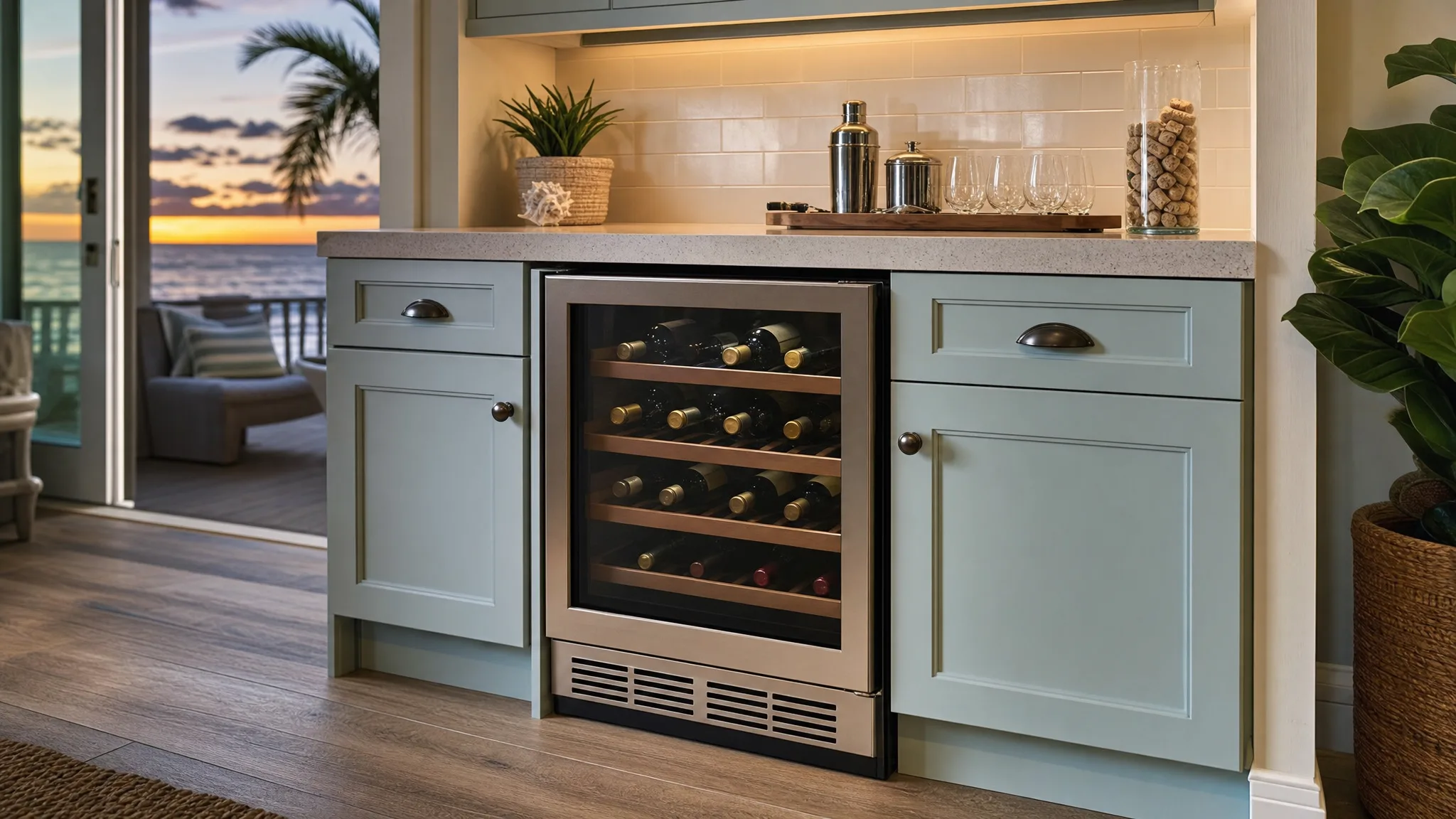
What an Electrician Checks Before Reusing an Existing Outlet
A receptacle that powers a lamp is not proof that it is suitable for a refrigeration appliance. An assessment starts with the appliance and proposed location, then examines the supply serving that location.
Appliance requirements and installation conditions
The electrician reviews the required supply, grounding provisions, circuit instructions, and cord arrangement. They also consider whether the appliance is intended for built-in or freestanding installation. A cooler that fits inside a cabinet opening may still be unsuitable for that enclosure.
If the appliance has not been purchased, sharing the proposed model’s installation manual can help identify electrical or placement conflicts before delivery. A sales description alone may leave out important installation restrictions.
Circuit identification and shared loads
Panel labels are useful starting points, but they may be incomplete or outdated after remodeling. Circuit tracing helps establish what the outlet actually shares with other rooms or equipment. Two nearby receptacles are not necessarily on different circuits, and an outlet on another wall may still share the same breaker.
For a Cocoa Beach wet bar, the review might reveal that the proposed outlet also supplies living-room receptacles. In a kitchen, the circuit may serve countertop appliances and be subject to specific restrictions. Those are different situations, even if both outlets look identical.
Receptacle condition, wiring, and protective devices
Checks may include grounding, polarity, plug retention, accessible connections, conductor suitability, breaker compatibility, and existing GFCI or AFCI protection. Discoloration, cracking, corrosion, or a plug that falls loosely from the receptacle should be investigated rather than hidden behind new cabinetry.
In Cocoa Beach properties, visible evidence of moisture intrusion or corrosion deserves attention, especially where electrical equipment has been exposed to coastal conditions. That does not mean every indoor outlet needs replacement. It means the actual condition of the equipment should influence the diagnosis.
What should the assessment produce?
Ask for a clear explanation of whether the existing circuit can remain in use, whether a specific defect needs repair, or whether a new circuit is warranted. A useful recommendation distinguishes observed problems from optional improvements and identifies any concealed conditions that cannot be confirmed without further access.
If electrical testing points to an internal appliance problem rather than a branch-circuit defect, appliance service may be necessary. Installing a new circuit should not be used to avoid identifying the cause.

How Panel Capacity, Wiring Access, and Condo Rules Affect Installation
Does an empty breaker position mean there is enough capacity?
No. Physical breaker space and electrical capacity are different questions. The electrician must evaluate the panel rating, existing loads, approved breaker options, and any required load calculations. A spare-looking opening does not automatically make a circuit addition feasible.
A crowded panel also does not automatically mean the entire service must be replaced. Available options depend on the equipment and the overall electrical system. Panel damage, overheating, corrosion, or improper previous modifications may need correction before additional work proceeds.
Can wiring reach the cabinet without major disruption?
Accessible attic space, an open remodeling wall, or a suitable existing raceway can simplify installation. Concrete walls, finished ceilings, concealed framing, and fire-rated assemblies can complicate the route. Existing conduit is useful only if its condition, routing, and available capacity allow the proposed conductors.
In some locations, a surface-mounted raceway may reduce wall openings. Its appearance, physical protection, permitted use, and any association restrictions still need consideration. An estimate should describe the intended route and likely access openings rather than promise a completely concealed installation before the building is assessed.
Do Cocoa Beach condo owners need association approval?
Possibly. Check the association’s alteration requirements before scheduling work. Approval may be needed when a project affects common elements, shared electrical areas, concrete assemblies, or fire-rated walls and ceilings. Building management may also require contractor documentation, work-hour coordination, elevator reservations, or access arrangements.
Association approval and a government-issued electrical permit serve different purposes. Neither replaces the other. Deltron Electric’s discussion of electrical work and Cocoa Beach condo association approval provides additional planning context, but the requirements for your building and circuit installation must be checked separately.
Is an electrical permit required in Cocoa Beach?
Expect a new branch circuit to require an electrical permit and inspection; confirm the exact requirements for the property and scope before work starts. A limited repair or receptacle replacement may be treated differently. A Cocoa Beach mailing address alone does not establish which permitting authority has jurisdiction.
For property within city jurisdiction, use the official City of Cocoa Beach website to reach the Building Department and verify current procedures. Confirm:
- Whether the proposed work requires a permit and who will obtain it.
- Which inspections apply, including any inspection before wiring is concealed.
- What documents are needed for the application.
- Which electrical code edition and local amendments govern the project.
This article does not establish a permit exemption or approval for a particular address. Current local requirements need project-specific verification, and the electrical design should receive qualified review before installation.
Outlet Placement, GFCI/AFCI Protection, and Appliance Clearances
Where should an under-counter refrigerator outlet go?
The under-counter refrigerator outlet should follow the appliance’s installation diagram and provide room for the plug and cord without crushing, stretching, or pinching them. A receptacle directly behind the appliance can interfere with installation depth or place the cord against equipment that produces heat.
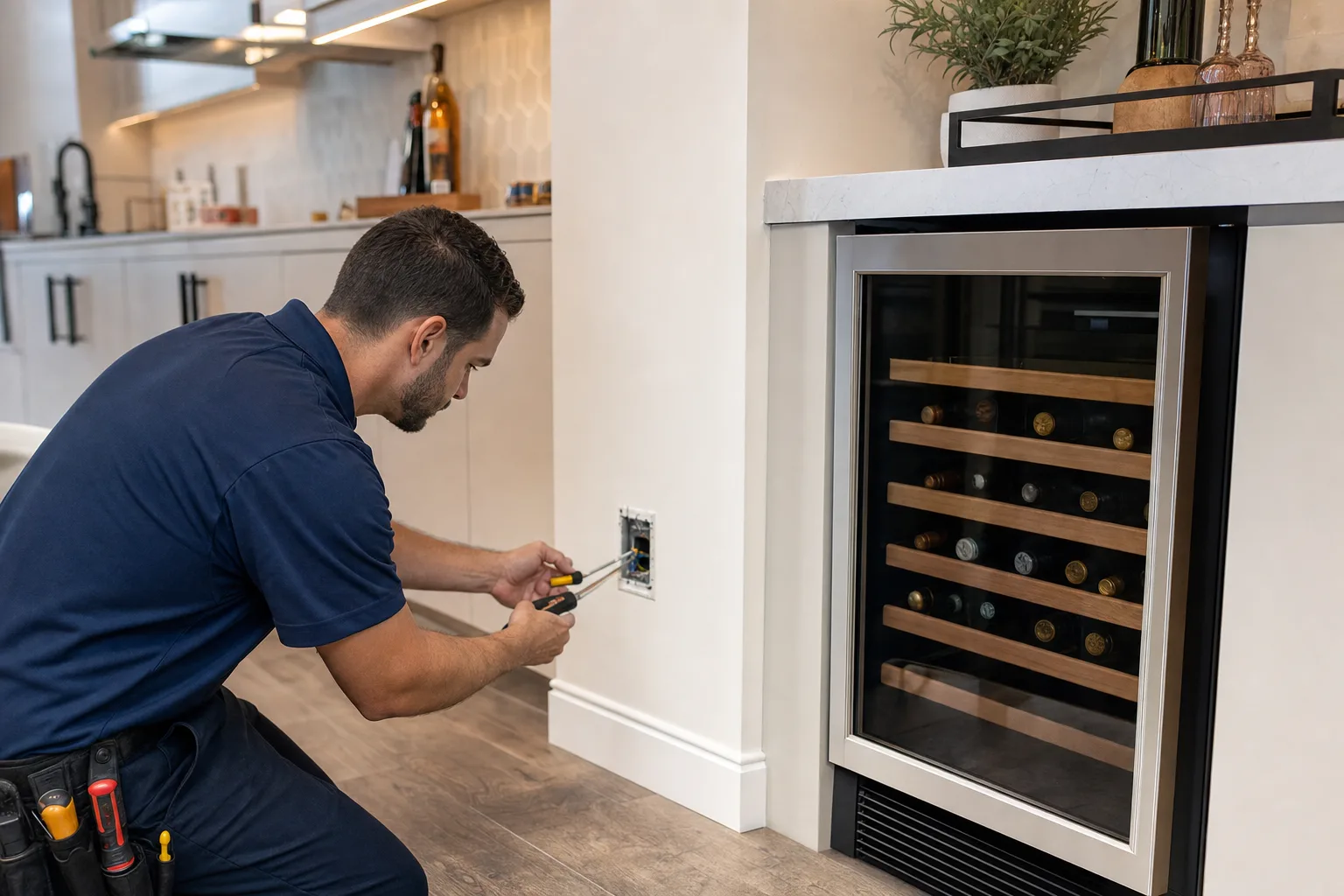
An adjacent cabinet location may be appropriate for some models, but it is not a universal answer. Cord length, permitted routing, protection at cabinet openings, and required access all need review. Do not use an extension cord, power strip, or grounding adapter to compensate for a poorly placed or unsuitable outlet.
Coordinate the outlet location before cabinetry is finalized. Drawer travel, plumbing, cabinet backs, and the appliance’s service requirements can all affect placement. The planning considerations in moving an outlet during a kitchen remodel also apply to a new beverage cabinet.
Does an under-counter wine refrigerator need GFCI protection?
It may, and a dedicated circuit does not create an exemption. GFCI protection requirements depend on the location, applicable electrical code edition, and project scope. Kitchen and wet-bar installations deserve particular review; distance from a sink is not the only possible trigger.
GFCI protection helps address shock hazards. AFCI protection addresses certain arcing hazards and may also be required. Neither substitutes for grounding or properly installed wiring. The electrician should establish which protections apply under the locally enforced edition of NFPA 70, the National Electrical Code, and any applicable amendments.
Where a GFCI device has test and reset controls, its location must meet applicable accessibility requirements. Avoid planning an arrangement that requires pulling out a heavy built-in appliance whenever a reset is needed. The appropriate protection method and location should be resolved before installation.
If the appliance trips required protection, diagnose the cause. Removing or bypassing that protection is not an acceptable troubleshooting shortcut.
Can a freestanding cooler be installed inside a cabinet?
Only if the manufacturer permits that arrangement and the specified clearances can be maintained. Freestanding models may need airflow around surfaces that an enclosed cabinet blocks. Built-in models also have defined ventilation requirements.
New wiring cannot correct trapped heat or an unsuitable cabinet opening. Check the electrical requirements and the ventilation plan together so the finished installation does not solve one problem while creating another.
What Changes the Cost and Timeline of Adding a Circuit?
There is no reliable single price for dedicated circuit installation in Cocoa Beach without knowing the appliance, panel, and wiring route. A short straight-line distance does not necessarily mean a short installation. The actual path around finished spaces can matter more.
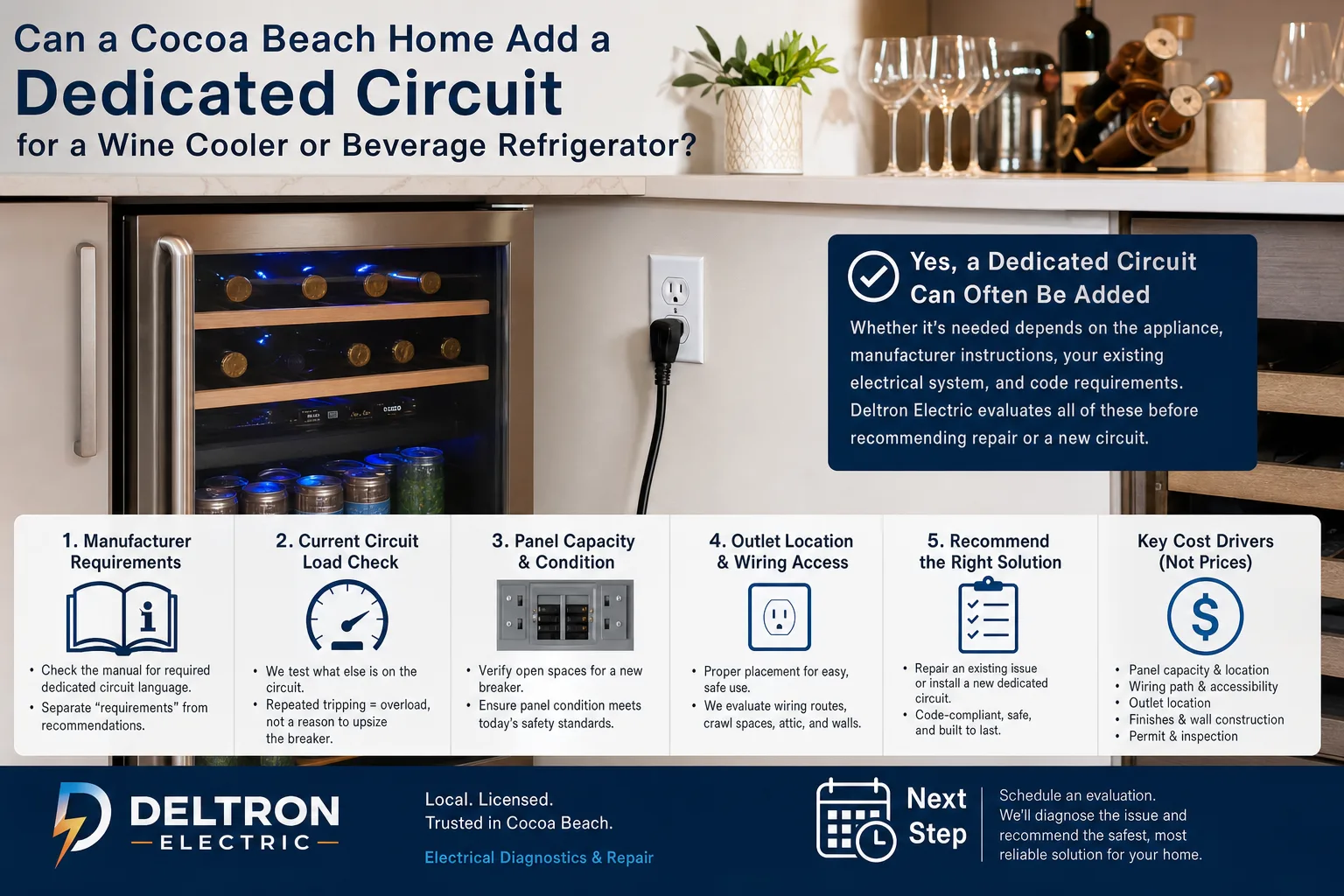
The most useful estimate distinguishes electrical diagnosis, required repairs, new circuit work, and any separate restoration or building coordination.
| Cost or scheduling factor | What to clarify |
|---|---|
| Existing circuit suitability | Can the existing supply be used safely, or is repair, relocation, or a new circuit necessary? |
| Panel condition and capacity | Is there an approved breaker position and adequate capacity? Are corrections needed first? |
| Actual wiring route | Can wiring pass through accessible areas, or must it cross finished rooms or difficult construction? |
| Wall and ceiling assemblies | Will work involve concrete, concealed framing, or penetrations requiring approved firestopping? |
| Receptacle and protective devices | Which compatible devices are required, and where can they be installed with suitable access? |
| Permits and condo coordination | Who handles applications, inspection scheduling, association authorization, and building access? |
| Finish restoration | Are drywall repair, painting, and cabinet modifications included or handled separately? |
Ask whether the estimate includes circuit identification, labeling, testing, permit handling, and anticipated access openings. Also ask what concealed discoveries could change the scope. Comparing two totals is not useful if one includes restoration and permitting while the other does not.
The schedule may include an assessment, association authorization where applicable, permit processing, installation, and inspections. An open-wall remodel can simplify rough wiring, while a finished condo may require building coordination before installation can begin. Electrical labor time and total project duration are not the same.
For rental properties, coordinate tenant access and any necessary power interruption in advance. If inspections must occur before walls are closed, align the electrician’s schedule with the cabinet installer and finish trades.
Common Questions About Tripping Breakers and Installation
Can my wine cooler share an outlet circuit with other kitchen appliances?
Possibly, if the manufacturer’s instructions permit it, the branch circuit is allowed to serve the appliance, and sufficient capacity is available. Kitchen small-appliance circuits have specific rules, so a nearby countertop outlet should not automatically be treated as a general-purpose supply for any new installation.
The relevant question is what the entire circuit serves—not whether the second socket on a duplex receptacle is empty. Have the supplying circuit identified before relying on it.
Will a dedicated circuit fix a beverage refrigerator that keeps tripping the breaker?
Only if the new circuit resolves the actual cause, such as an unsuitable shared load. A wine fridge tripping a breaker can also indicate a damaged cord, wiring defect, ground fault, internal appliance problem, or defective protective device. Compressor startup may reveal a problem, but it does not identify that problem by itself.
Useful observations include whether the trip occurs immediately, when cooling starts, or only while other equipment runs. Note whether the device that trips is a standard panel breaker, a GFCI receptacle, or a breaker with GFCI/AFCI functions. Record symptoms without deliberately reproducing repeated trips.
Can the breaker simply be replaced with a larger one?
No—not as a shortcut for repeated tripping. Breaker sizing must protect the installed conductors and comply with circuit requirements. Increasing the rating without establishing suitability can leave wiring inadequately protected. A replacement breaker must be correctly specified and justified by the diagnosis.
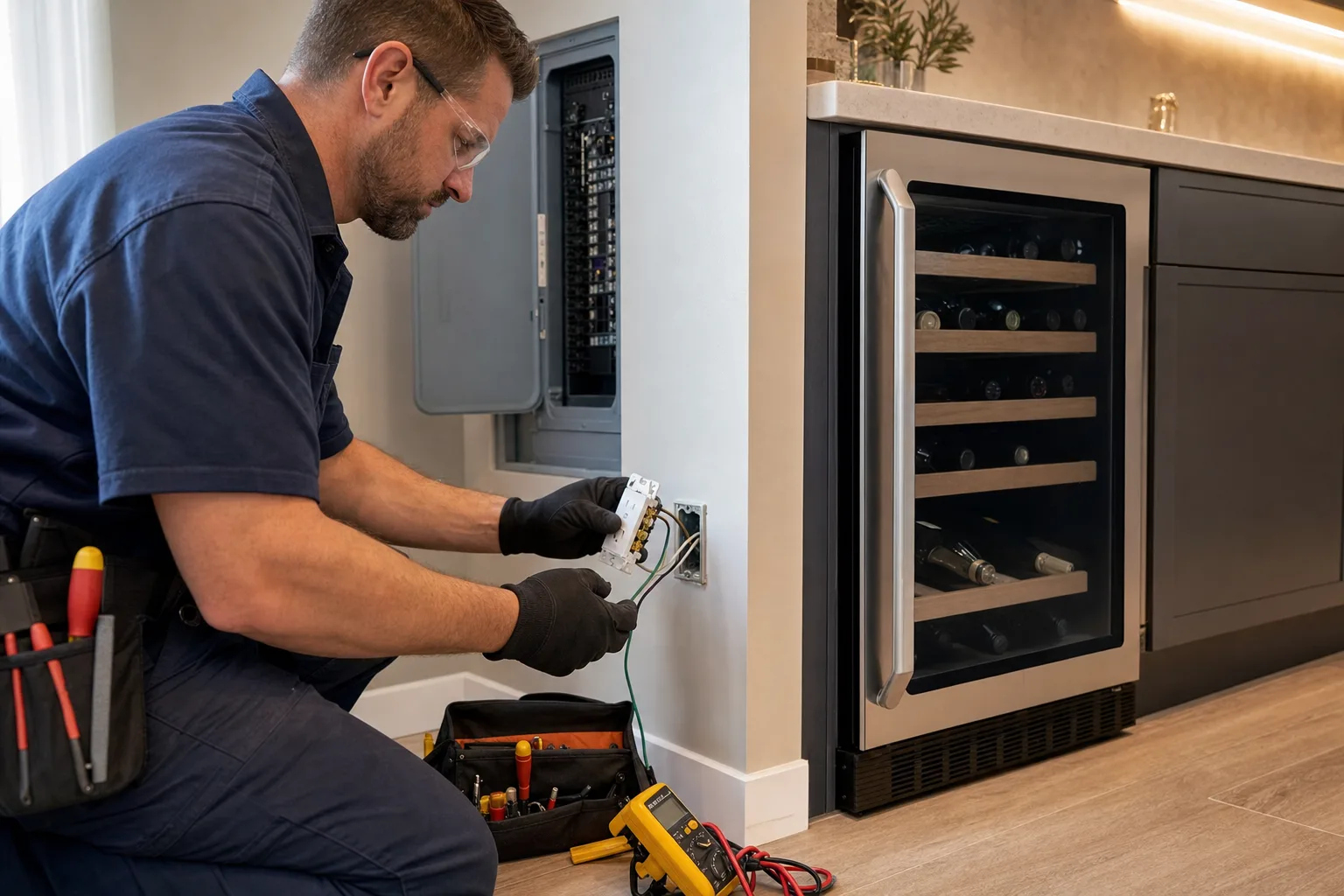
Do not repeatedly reset a device that continues to trip. Stop using the affected equipment if there is a burning odor, unusual heat, sparking, discoloration, or a damaged connection. Keep away from visibly damaged electrical equipment and arrange professional evaluation. Smoke or active fire warrants emergency assistance.
Can the circuit be installed without opening walls?
Sometimes. Accessible attic space, suitable existing conduit, or an acceptable surface route may limit openings. Finished construction can prevent a fully concealed, no-opening installation. Ask the electrician to explain the available routes, likely access points, and restoration responsibilities before authorizing work.
Should a working but loose outlet be replaced before the cooler is installed?
A loose plug connection requires evaluation even if the appliance currently runs. Poor contact can create heat, and a receptacle hidden behind a cooler is less likely to receive routine attention. The electrician should determine whether the issue is limited to the receptacle or involves its connections, box, or wiring.
Are garage refrigerator circuits planned the same way?
Some principles overlap, including manufacturer instructions, circuit loading, and diagnosis of tripping. Garage environments and protection requirements still require their own review. For that separate situation, see dedicated circuits for garage refrigerators and freezers. Garage advice should not automatically be transferred to a Cocoa Beach kitchen or condo wet bar.
What should rental property managers document?
Keep the appliance model, installation instructions, circuit identification, and records of completed electrical work together. If a tenant or guest reports tripping, record when it happens and what else was operating. Arrange diagnosis instead of leaving instructions to reset the breaker repeatedly.
What to Share With Deltron Electric Before a Service Visit
A few details can help Deltron Electric prepare for a more useful discussion and assessment:
- Appliance information: The complete model number, a readable rating-label photo, and the installation manual if available.
- Intended location: Whether the cooler will be in a kitchen, wet bar, or another cabinet, with photos of the opening and nearby outlet.
- Tripping symptoms: Which protective device trips, when it happens, and what other equipment is running.
- Panel information: A photo of the accessible panel face and circuit directory, without removing the panel cover or exposing wiring.
- Wiring access: Whether walls are open, attic access is available, or the property has concrete construction.
- Property coordination: Condo alteration rules, management contacts, tenant access restrictions, and remodeling dates.
Photos and model information can guide the initial conversation, but they cannot establish concealed wiring condition, verify all shared loads, or confirm panel capacity. An on-site assessment may include circuit tracing, electrical testing, and review of a practical wiring route before the final recommendation is made.
The goal is to identify a suitable existing supply, correct an electrical defect, or add a circuit when it is genuinely needed. That gives the appliance an appropriate installation without assuming every small refrigerator requires new wiring.
Not sure whether your planned wine cooler can use the existing outlet? Contact Deltron Electric at (833) 335-8766 with the appliance model, intended location, and any tripping symptoms to discuss your electrical needs and schedule a service visit in Cocoa Beach. An on-site assessment may be needed to confirm whether the right solution is using the existing circuit, repairing an electrical problem, relocating the outlet, or installing a dedicated circuit.