


What Size Electrical Panel Makes Sense for a Titusville Home Adding New Appliances or a Future EV Charger?
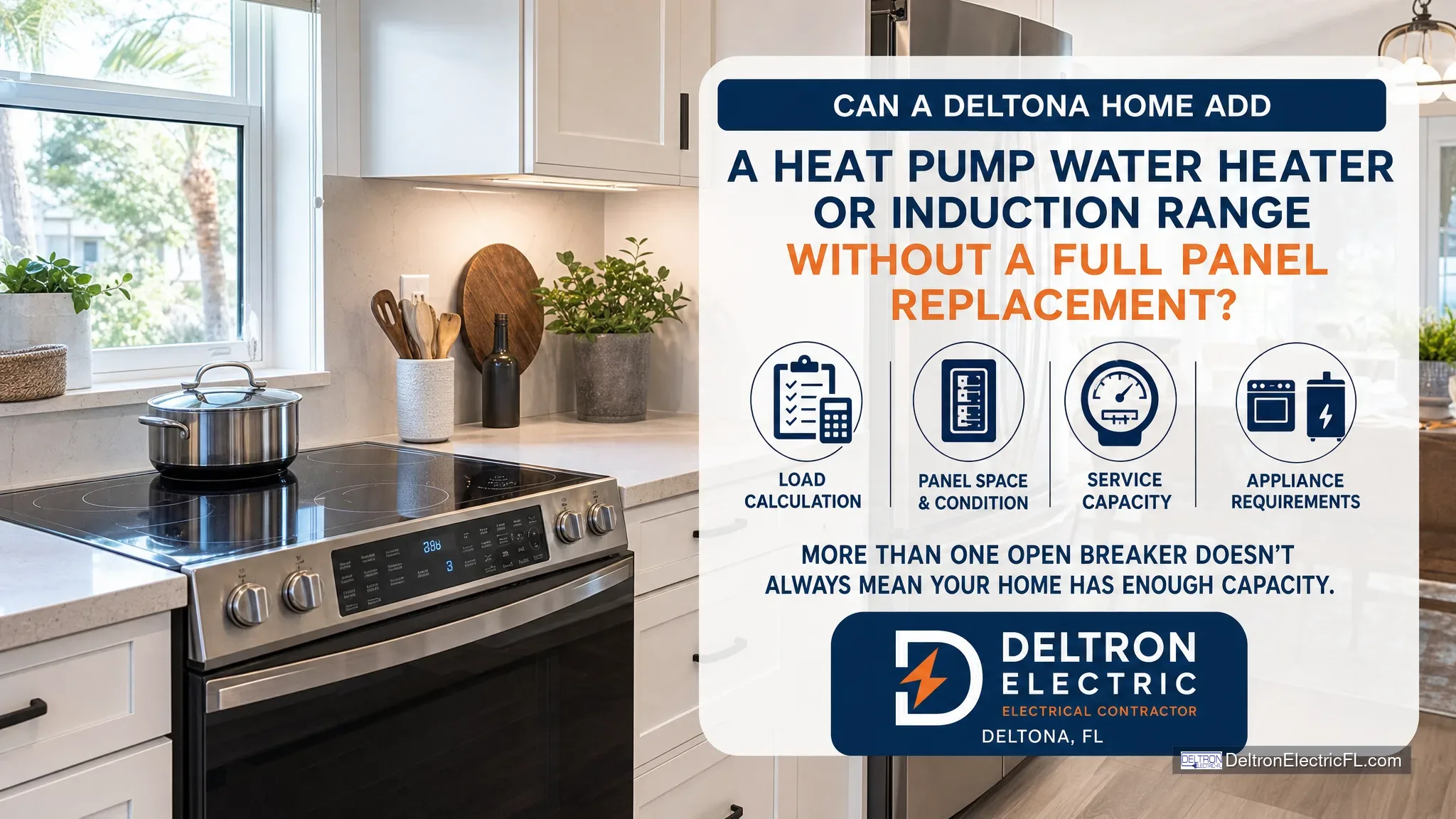
For Deltona homeowners planning a heat pump water heater, induction range, future EV charger, standby generator, or another major appliance, the practical answer is this: you may not need a full electrical panel replacement, but you should not assume your current panel can handle the new load based on its size or an empty breaker space alone.
The right decision depends on a professional electrical load calculation, the number of usable breaker spaces, the condition of the panel and service equipment, and the electrical requirements of the exact appliances you plan to install. A 100-amp, 150-amp, or 200-amp label is useful information, but it is only one part of the evaluation.
Whether you are comparing options in Deltona, Titusville, Melbourne, Palm Bay, Merritt Island, or elsewhere on the Space Coast, planning before purchasing equipment can prevent installation delays, unexpected panel work, and safety concerns.
Short Answer: It May Be Possible Without Replacing the Panel
A new electric appliance does not automatically mean your Deltona home needs a larger electrical service or a new panel. Some homes have enough calculated capacity, room for an additional properly sized circuit, and panel equipment in good condition. In that case, an electrician may be able to install the needed circuit without replacing the entire panel.
Other homes have one or more limitations that change the recommendation:
- The panel may have no open breaker positions for a new circuit.
- The service may not have enough calculated capacity for the existing loads plus the planned appliance.
- The panel may show age, corrosion, overheating, improper connections, or equipment concerns that should be addressed before adding load.
- The service equipment may be adequate for today’s appliance but not for the homeowner’s larger electrification plans.
- The planned appliance may have a higher electrical demand than expected based on its specific installation instructions.
For example, a homeowner replacing a gas water heater with a heat pump water heater may only need a new dedicated circuit if the load calculation and panel condition support it. But if that same homeowner also intends to replace a gas range with induction, add garage charging for an EV next year, and install a generator inlet or standby generator later, reviewing each project separately can lead to piecemeal work.
A coordinated plan gives you a clearer answer about whether a circuit addition is appropriate now, whether a panel replacement makes more sense, or whether a service upgrade should be considered as part of a larger project. Deltron Electric provides electrical panel replacement in Deltona for homeowners whose evaluation shows that existing equipment is not the right foundation for new loads.
Why Appliance Breaker Size Does Not Tell the Whole Story
It is common to focus on the breaker size listed for a new appliance. That number matters, but it does not answer the question, “Can my home handle this?”
A breaker protects the branch circuit serving that individual appliance. It does not, by itself, prove that the home’s electrical service can safely supply all household loads that may operate at the same time. The panel’s total rating also does not automatically indicate how much unused capacity remains.
An electrical load calculation considers the home as a complete system. Depending on the home and planned work, that review may account for:
- General lighting and receptacle loads
- Existing electric range, oven, dryer, water heater, and cooking equipment
- Air-conditioning and heating equipment
- Pool, spa, well, workshop, or other dedicated equipment where applicable
- New appliance nameplate information and manufacturer instructions
- Planned EV charging, generator equipment, or other future electrical loads
- Applicable demand factors and electrical code requirements
That is why adding a circuit is not as simple as finding a blank space and installing a breaker. A blank position addresses only one question: whether there may be physical room for a breaker. It does not confirm available service capacity.
Conversely, a panel that appears full may still have adequate calculated service capacity. In that situation, the issue could be breaker space rather than total amperage. Depending on the panel’s listed equipment and configuration, a qualified electrician may determine that a permitted solution such as a properly approved tandem breaker, subpanel, circuit reorganization, or panel replacement is appropriate. These options are not interchangeable, and they do not solve every problem.
Breaker Space, Service Capacity, and Panel Condition Are Different Issues
Homeowners often hear “your panel is full” and understandably assume that the electrical service is undersized. Sometimes that is true, but not always. It helps to separate the three core questions:
- Breaker space: Is there a listed, safe physical location for the new breaker and circuit?
- Service capacity: Does the electrical load calculation support the existing loads plus the new equipment?
- Panel condition: Is the panel, breaker system, bus, wiring, grounding, and service equipment in acceptable condition for continued use and added load?
A home can have an open space but insufficient capacity. It can have sufficient capacity but no breaker space. It can have both capacity and space but still need attention because the panel is in poor condition. In some homes, all three concerns are present at once.
Heat Pump Water Heater Electrical Needs: What to Check First
Heat pump water heaters can be an appealing option for homeowners reducing gas use or replacing aging water-heating equipment. However, the heat pump water heater electrical requirements must come from the chosen unit’s nameplate and installation instructions, not from a generic online estimate.
Before buying a model, gather the manufacturer’s electrical information and confirm:
- Required voltage
- Required circuit rating and overcurrent protection
- Whether the unit requires a dedicated branch circuit
- Location requirements and whether the installation area affects wiring access
- Any disconnecting means or receptacle requirements listed by the manufacturer
- Whether auxiliary electric elements change the unit’s electrical design needs
Some heat pump water heaters may have modest electrical needs compared with other major appliances, but that does not make the evaluation optional. The circuit still has to be correctly designed and installed, and the home’s overall load still needs to be considered.
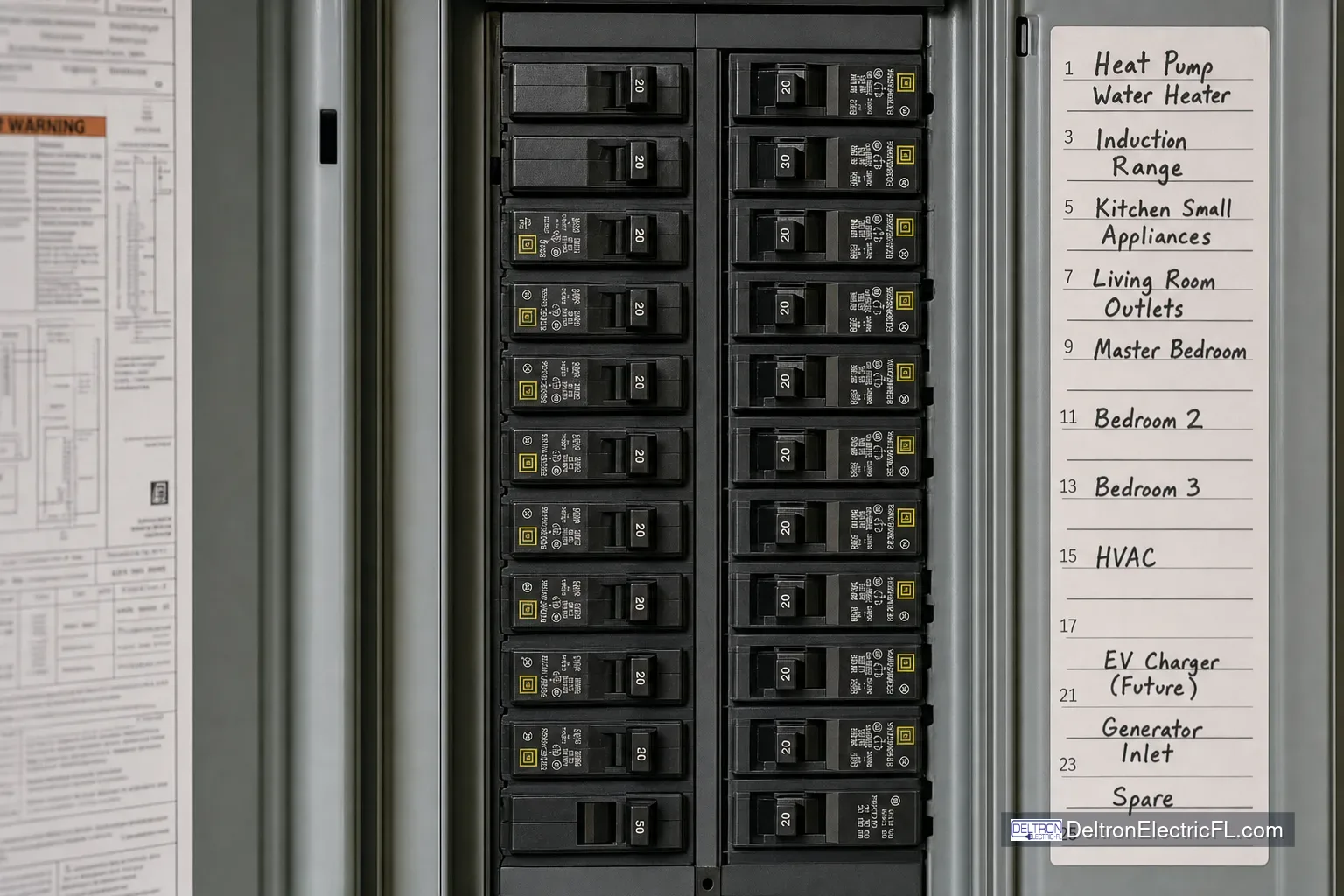
In a Deltona home with an older panel, the electrician may also check whether the existing panel has signs of moisture exposure, corrosion, loose connections, or heat damage. Florida’s humidity and storm conditions make the condition of electrical equipment especially worth taking seriously.
If you are also considering induction cooking, an EV charger, or a generator, share that information before the water-heater work begins. The best solution for one appliance may not be the most cost-effective or practical plan for several anticipated upgrades.
Induction Range Electrical Needs: Why the Appliance Model Matters
An induction range is not a one-size-fits-all electrical project. Some homeowners expect every induction range to require the same circuit, but induction range electrical requirements vary by model. The appliance documentation identifies the required voltage, circuit rating, wiring configuration, and other installation details.
Do not choose a breaker size based solely on what a neighbor installed or what an older electric range used. The circuit must match the selected appliance and applicable electrical requirements. An electrician will review the model information and determine whether an existing range circuit can be used, modified, or replaced, and whether the home’s load calculation supports the conversion.
This matters particularly when replacing a gas range. A gas range may have used only a standard receptacle for ignition and controls. An induction range can require an entirely new dedicated circuit and a route for wiring from the electrical panel to the kitchen. The panel capacity question and the wiring-path question are both part of the project.
It is also important to think about how your household uses power. An induction range, air conditioner, dryer, water heater, and other high-demand equipment may overlap during normal family routines. The electrical load calculation is designed to evaluate the home more realistically than simply adding breaker handle ratings together.
When an Existing Deltona Panel Can Support the New Load
An existing panel may be suitable for a new appliance circuit when a qualified evaluation confirms that all of the following are in place:
- The service load calculation supports the new equipment.
- The panel has a listed method for adding the required breaker space.
- The panel and breakers are in sound condition.
- The conductors, grounding and bonding, and service equipment are appropriate for the installation.
- The appliance circuit can be routed and protected correctly.
- The work can meet applicable permitting and inspection requirements.
Sometimes a circuit rebalancing arrangement can improve how circuits are organized in a panel. In certain listed panel designs, approved tandem breakers may create room for an additional circuit. A subpanel may be useful where a main panel has adequate service capacity but needs more distribution space.
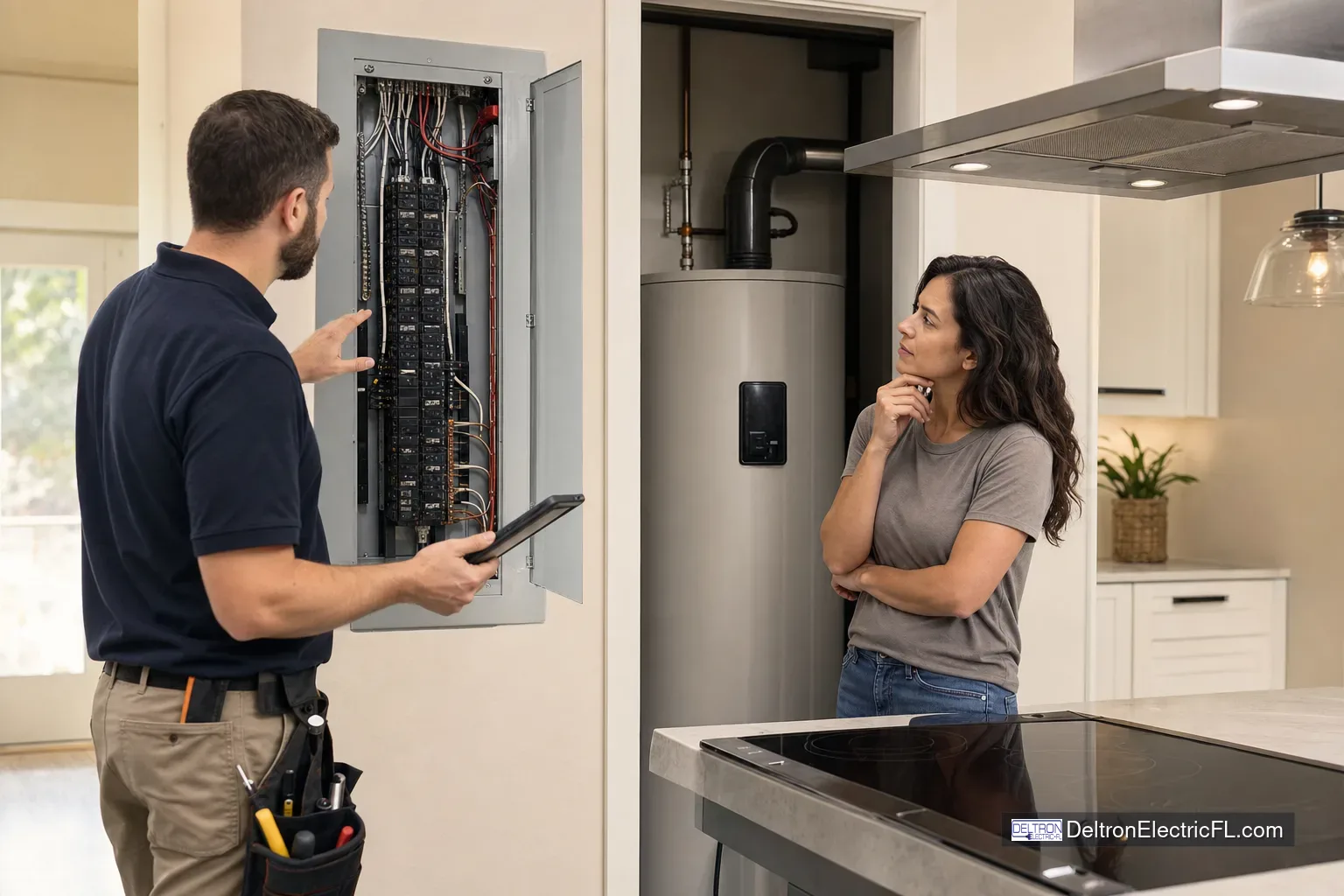
However, these measures have limits. Tandem breakers cannot be installed in every panel or every breaker position. They do not add capacity to the electrical service. Circuit rebalancing does not turn an overloaded service into an adequate one. A subpanel adds circuit spaces, but it is fed from the existing service and does not increase the service rating.
That distinction is central to good electrical panel upgrade education: a solution for space is not necessarily a solution for capacity, and a solution for capacity does not automatically correct panel-condition problems.
Signs a Panel Upgrade or Replacement May Be the Safer Choice
A panel upgrade or replacement may be recommended when the evaluation identifies insufficient capacity, deteriorated equipment, unreliable breaker space options, or an upcoming group of electrical projects that would otherwise require repeated modifications.
Reasons to discuss a larger or replacement panel may include:
- A load calculation shows the existing service cannot reasonably support planned appliances.
- The panel is full and is not listed for tandem breakers in the locations needed.
- The panel has recurring tripped breakers, overheating, corrosion, damaged components, or evidence of improper prior work.
- Breaker labels are missing, inaccurate, or difficult to verify during the evaluation.
- The home has an older panel that is no longer a dependable platform for substantial additions.
- You intend to add multiple major loads over the next few years.
- A generator project, EV charging plan, kitchen renovation, or conversion from gas appliances changes the overall electrical design.
Panel noise deserves prompt attention as well. A properly operating panel should not buzz, crackle, or hum. If you have noticed that type of issue, read more about why an electrical panel may buzz and arrange an electrical assessment rather than adding new load to equipment that may already need repair.
A replacement decision is not just about obtaining a larger number on the panel label. It is about creating a safe, code-conscious distribution system that is suitable for the home’s actual loads and future plans. Deltron Electric’s panel installation services in Deltona can help homeowners understand the practical options when the current panel does not provide the needed space, condition, or capacity.
What an Electrician Checks During a Load and Panel Evaluation
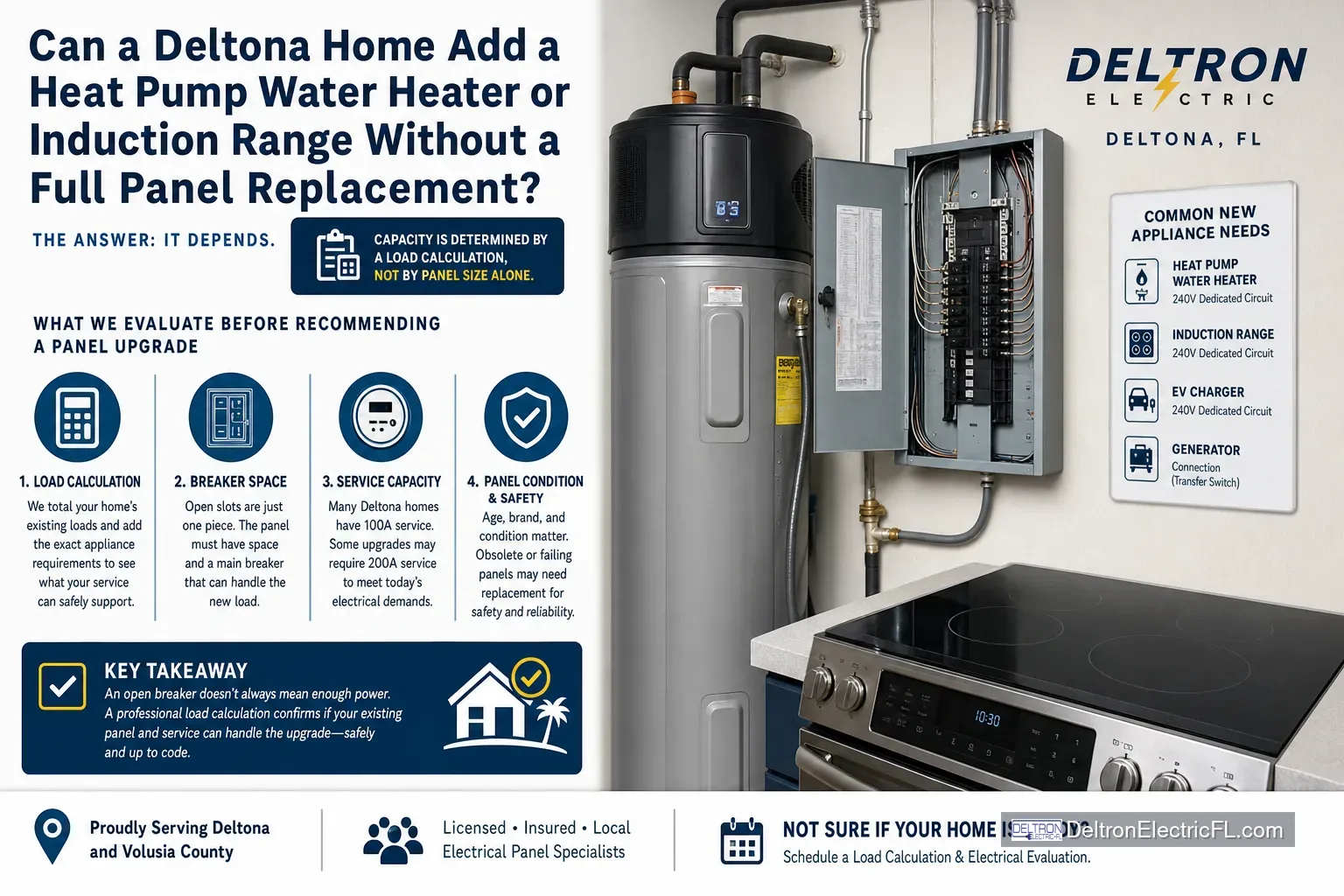
A capacity review should provide more useful information than a quick look at the panel door. For electrification upgrades such as induction cooking and heat pump water heaters, an electrician typically needs to understand the existing electrical system, the selected appliance, and the homeowner’s future plans.
Information About the Existing Electrical System
The evaluation may include a review of the panel rating, breaker layout, circuit labels, service conductors, visible wiring condition, grounding and bonding, and available locations for new circuits. The electrician also checks for warning signs such as damaged breakers, discoloration, corrosion, loose components, or overcrowded wiring.
Information About the Planned Appliance
The appliance model number is especially valuable. Manufacturer instructions and nameplate data guide the circuit design. A product listing page or a verbal description such as “a heat pump water heater” is not enough to determine the correct circuit in every case.
A Whole-Home Electrical Load Calculation
The load calculation examines the home’s existing and planned electrical demand under standards used for residential electrical design. It is not a homeowner guess and should not be replaced by adding up every breaker rating. Electrical load calculations use specific methods, and permits and inspections may apply to new circuits, panel work, and service upgrades depending on the project and local jurisdiction.
Current local requirements should be confirmed with the applicable permitting authority. A professional evaluation can help define the scope before equipment is purchased or work begins, but final installation requirements depend on the specific property, equipment, code provisions, and inspection process.
Future Load Planning
Future plans often change the recommendation. Even if an existing panel can support one heat pump water heater today, an electrician may advise planning differently if you expect to install an induction range, EV charger, pool equipment, or generator equipment later.
This is not an attempt to overbuild every home. It is a way to avoid making a one-appliance decision that creates unnecessary rework when the next upgrade arrives.
Plan for Future Loads Before Making a One-Appliance Decision
Home electrification tends to happen in stages. A homeowner may replace a failed water heater now, update the kitchen later, then purchase an EV or add generator equipment after the next storm season. Each individual project can appear manageable, while the combined demand and panel-space needs tell a different story.
Before requesting an estimate, gather what you can:
- The model numbers or product links for planned appliances
- A clear photo of the panel label and the inside breaker directory, if it is safe to do so without removing covers
- Photos showing the panel area and potential appliance location
- Information about existing electric heating, air conditioning, dryer, water heater, pool, spa, workshop, or garage equipment
- Your expected timeline for an EV charger, induction range, generator, or other large electrical addition
- Any history of breakers tripping, flickering lights, panel noises, or prior electrical repairs
Do not remove the panel cover or attempt to identify wiring inside the panel yourself. The useful homeowner information is usually available from the exterior label, breaker directory, appliance documents, and visible conditions around the panel.
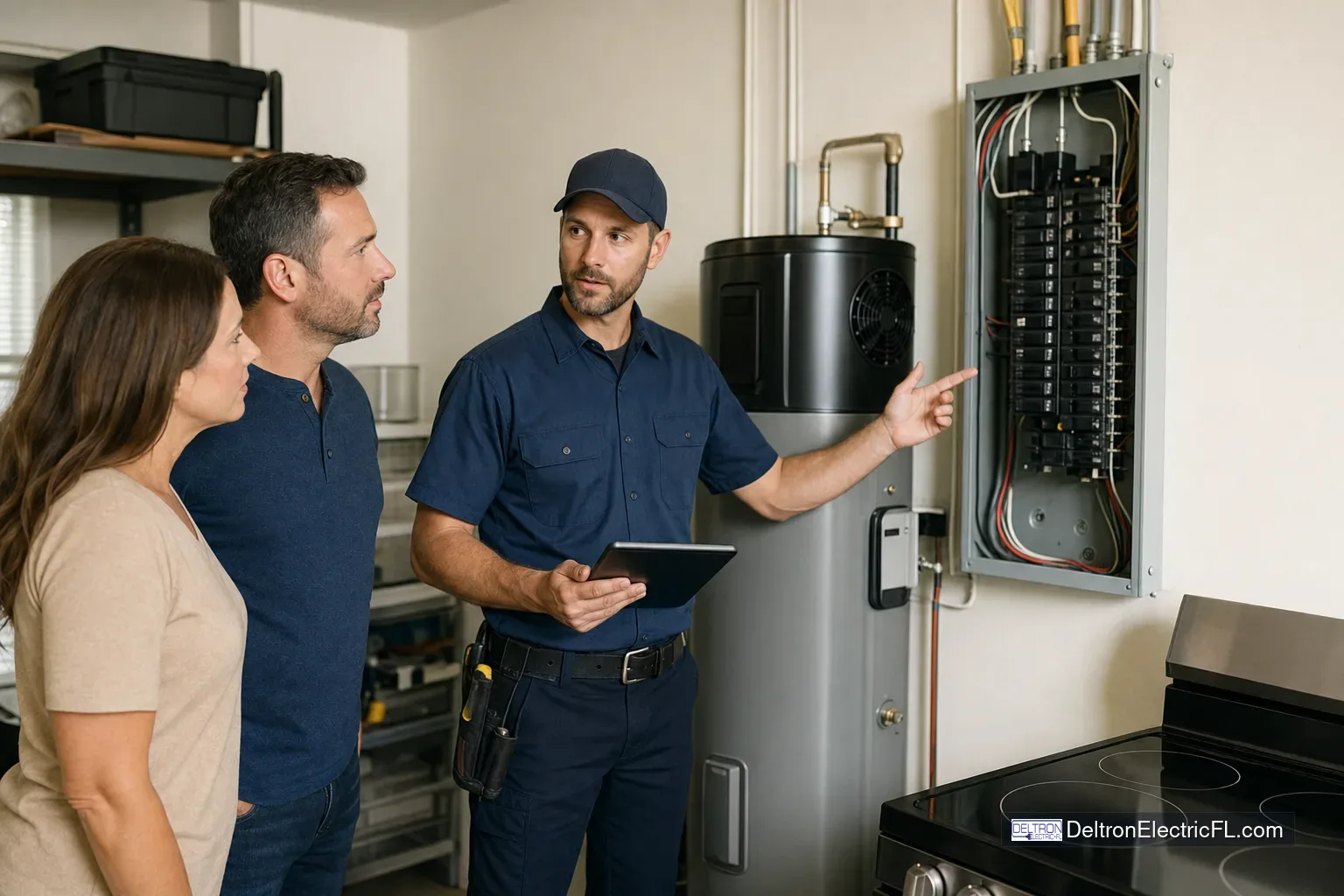
Reviewing appliance plans together is particularly useful for a homeowner who may add an EV charger later. The charger does not need to become the focus of every project, but it should be part of the planning conversation. The same is true for generator plans: generator equipment may involve separate design considerations, transfer equipment, selected loads, and the condition of the existing service equipment.
Frequently Asked Questions
Can I add a heat pump water heater if my Deltona home has a 100-amp electrical panel?
Possibly. A 100-amp panel does not automatically prevent a heat pump water heater installation, and it does not automatically confirm that one is acceptable. The answer depends on the home’s existing electric loads, the selected water heater’s requirements, available breaker space, and panel condition. A professional load calculation and equipment review provide the reliable answer.
Does an induction range always require a 50-amp breaker and a panel upgrade?
No. The required circuit must be based on the specific induction range manufacturer’s instructions and nameplate information. Some models may have different electrical requirements. A panel upgrade is only needed if the existing system lacks adequate capacity, usable breaker space, acceptable condition, or another required component of the installation.
If there is an empty breaker space in my panel, does that mean I have enough electrical capacity?
No. An empty space may mean there is a place for a breaker, but it does not establish that the service can safely support another major load. Available capacity is determined through an electrical load calculation, not by panel size or empty spaces alone.
What happens if my panel is full but the electrical service still has available capacity?
If capacity is available, an electrician may consider solutions such as an approved tandem breaker arrangement where the panel listing permits it, circuit reorganization, a subpanel, or a panel replacement. The appropriate option depends on the specific equipment and the new circuit needed. These space-management options do not increase the home’s service capacity.
Should I evaluate my panel now if I may add an EV charger or standby generator later?
Yes. Sharing future plans during the current evaluation helps prevent a short-term appliance decision from limiting a later project. An electrician can assess the likely path for future circuits, panel space, calculated load, and whether your current equipment is a sensible long-term platform.
Get a Direct Answer Before You Buy the Appliance
The best panel size for a Deltona home is not determined by a single rule or a breaker-space count. It is determined by the home’s calculated load, equipment condition, available distribution space, appliance specifications, and the upgrades you expect to make next.
Do you have appliance model numbers, a photo of your panel label, or plans for future EV charging, induction cooking, a heat pump water heater, or generator equipment? Call Deltron Electric at (833) 335-8766 or schedule electrical diagnosis or service to get practical next-step help with a load and panel capacity review before you buy equipment or begin installation.