


Partial Power Loss in Palm Bay: When It’s an Emergency and When It Can Wait Until Business Hours
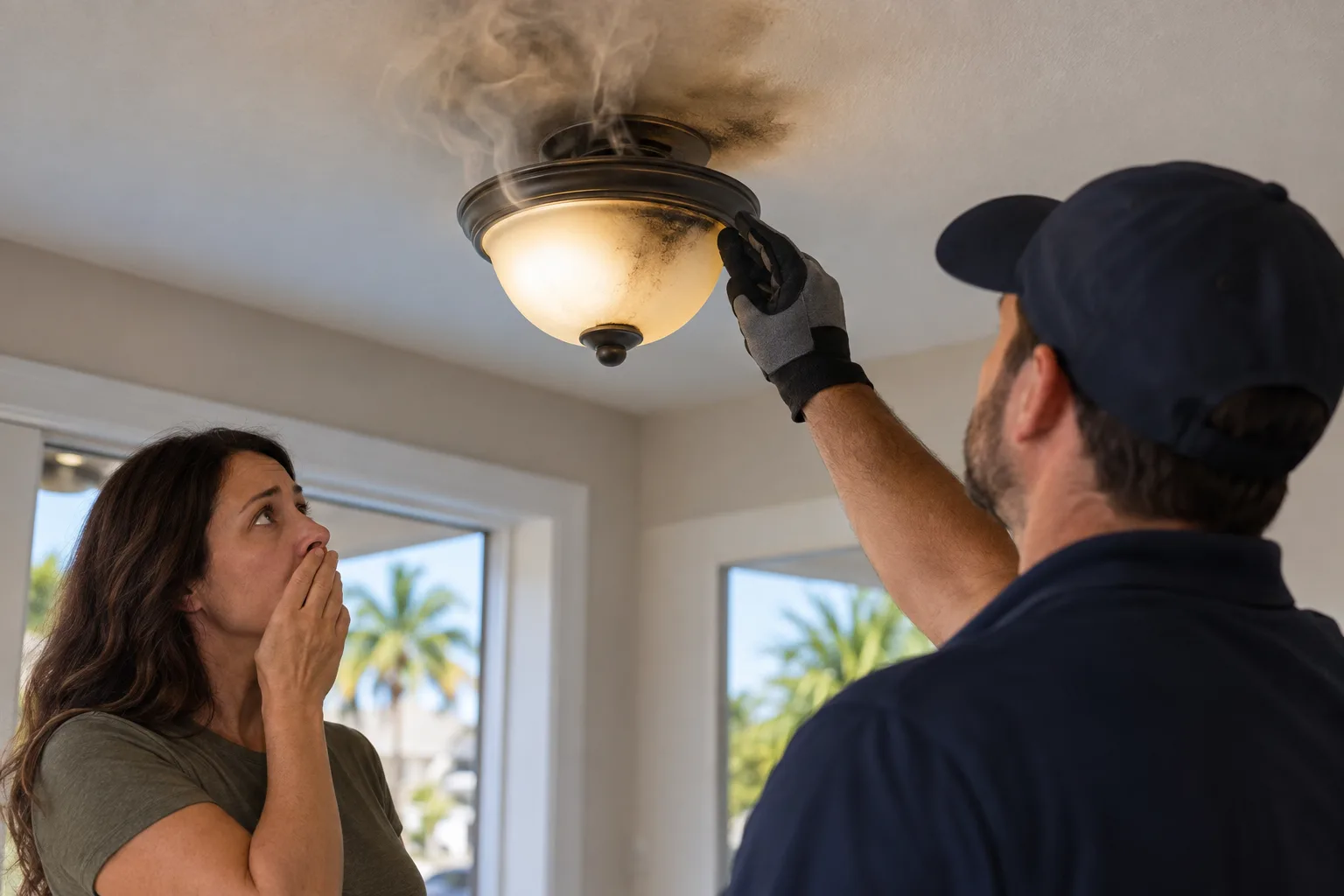
Some lights going out may point to a limited circuit problem. Smoke coming from a light fixture changes the situation: treat it as a potential electrical fire, not an ordinary outage. A burning smell, scorching, or unusual heat around a ceiling light also deserves immediate attention—not another attempt to make the light work.
For Palm Bay homeowners, condo residents, and property operators, the first decision is about protecting people. Electrical diagnosis comes afterward. Here is how to separate an emergency from a problem that may be scheduled for repair, and what needs to happen before the affected fixture or circuit is used again.
Quick Answer: Smoke From a Light Fixture Is a Potential Fire Emergency
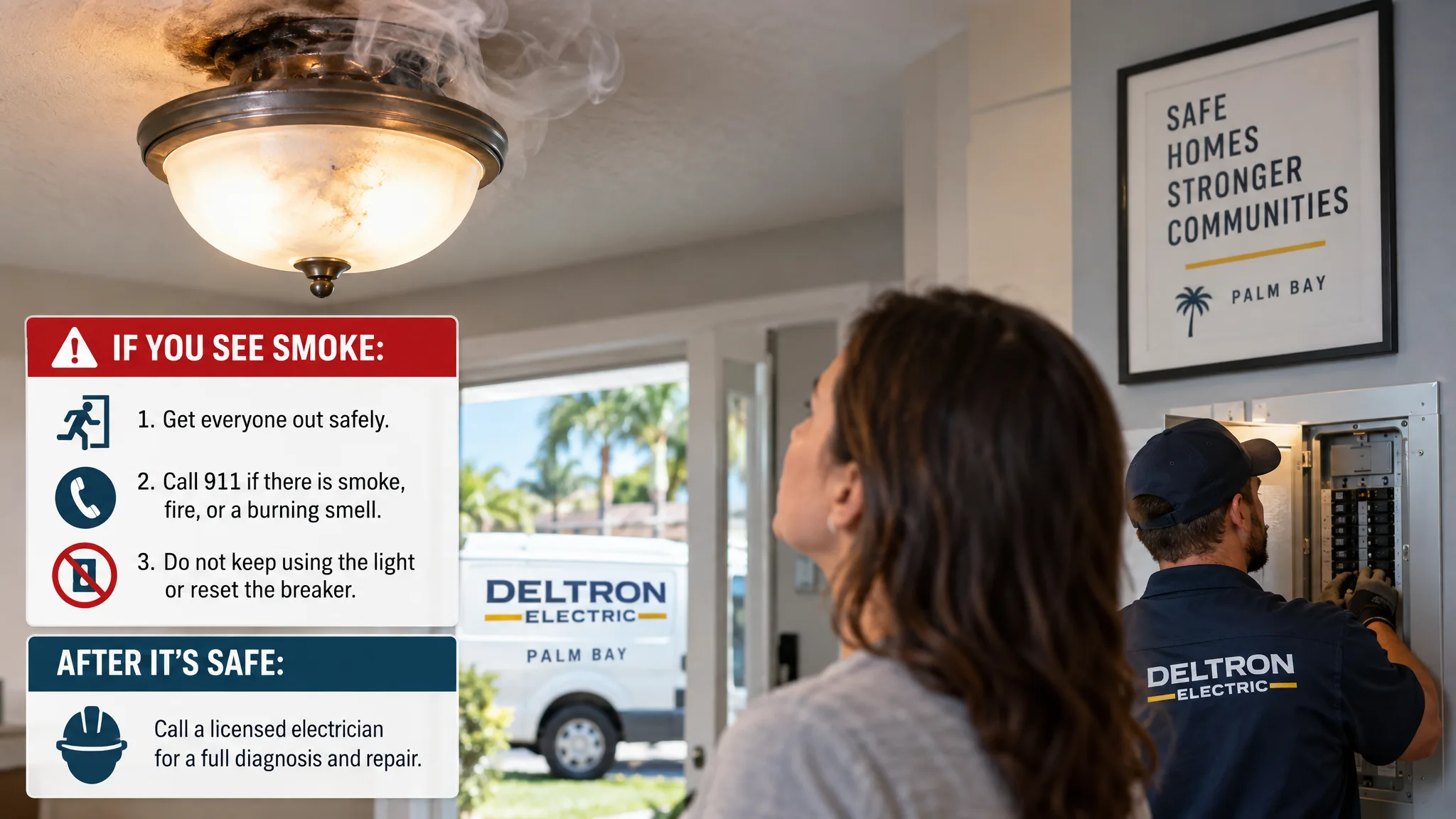
If a light fixture is smoking, get everyone out, stay outside, and call 911 from a safe location. Do not delay evacuation to switch off the fixture, locate a breaker, take photographs, or call an electrician. Tell the dispatcher where you noticed the smoke and whether anyone may still be inside.
An active, unexplained burning smell from a ceiling light—especially with crackling, discoloration, flickering, or heat damage—can indicate a concealed electrical problem even without visible flames. You do not need to see fire to call for emergency help. If you suspect something is burning in the fixture, ceiling, or wall, leave and call 911.
Emergency responders address the immediate fire hazard. An electrician’s later role is to identify the electrical fault, evaluate damage, and make appropriate repairs. Scheduling electrical service is not an alternative to calling 911 for a suspected fire.
| What you notice | What it means for your next step |
|---|---|
| Fixture smoke, flames, active sparking, or an unexplained burning odor suggesting fire | Leave, stay out, and call 911 from safety. Do not investigate the source. |
| Smoke has stopped after a fixture smoked | Stopped smoke does not rule out concealed fire. If responders have not assessed the incident, call 911 from safety and explain what happened. |
| Several rooms lose power, with some lights unusually bright and others dim | A service or neutral problem may be involved. Stop using affected equipment and promptly contact the utility and an electrician from a safe location. Fire signs require 911. |
| An isolated loss of power with no smoke, odor, heat damage, unusual sounds, water exposure, or other warning signs | It may be suitable for business-hours diagnosis if the affected area remains unused and no essential safety function is compromised. Do not assume it is harmless. |
The key distinction is not how many rooms have electricity. It is whether the symptoms suggest fire, hazardous voltage, water involvement, or loss of an essential service.
What to Do Now: Get Out, Stay Out, and Call 911 From Safety
Protect occupants before property
When a fixture smokes, stop using the area and begin leaving immediately. Alert other occupants as you exit. Assist children and anyone who needs help if you can do so without entering smoke or delaying your own escape. Close doors behind you when practical, but do not stop to collect belongings.
Use a safe escape route. In a condo or commercial building, follow the building’s fire evacuation procedures and use stairs rather than elevators during a suspected fire. Do not pass through smoke to reach a preferred exit. If you cannot escape safely, call 911, give your exact location, and follow the dispatcher’s instructions.
Once outside, move to your meeting place away from the building. Do not go back inside for pets, phones, keys, or electrical equipment. Tell responders about anyone or any pets still inside, rather than attempting a rescue yourself.
Give the dispatcher observations, not a diagnosis
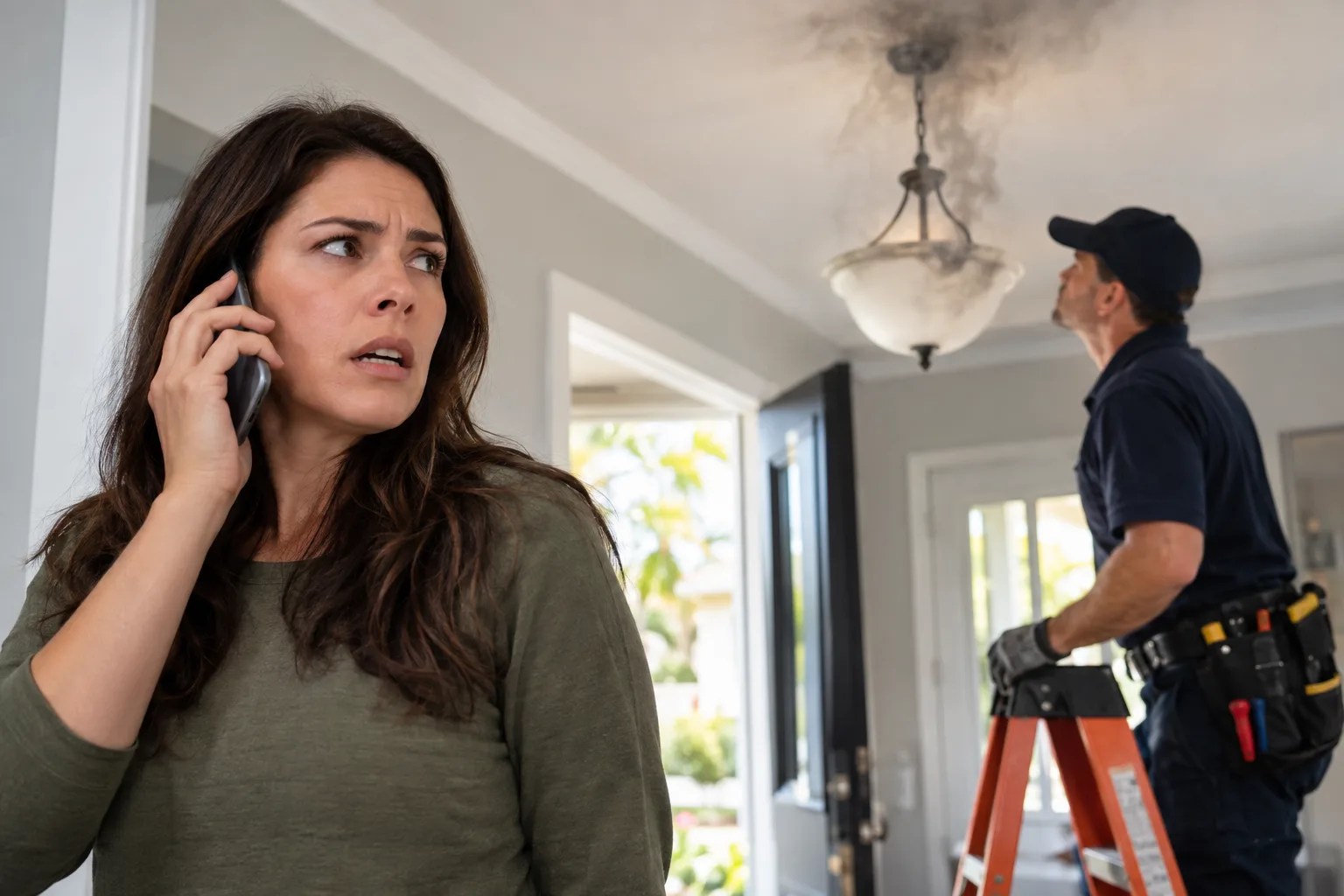
You do not need to know whether a bulb, wire connection, or LED driver failed. Useful information includes your address, unit or suite number, the room involved, what you saw or smelled, and whether smoke is still visible from where you are safely located.
For example, “There was smoke coming from the hallway ceiling light, and we are outside now” is more useful than guessing that the fixture only needs a bulb. If part of the property also lost power, mention that. Do not reenter to check whether the lights are still out.
The U.S. Fire Administration’s home fire safety guidance emphasizes planning an escape and getting outside during a fire. Electrical equipment can be repaired later; evacuation should not depend on confirming exactly what failed.
Notify management after emergency help is underway
Palm Bay renters should notify their landlord or property manager once they are safe and emergency services have been contacted. Condo residents should also notify the association or building contact when shared spaces, ceiling assemblies, or building systems may be involved.
A property manager should not ask a tenant to return inside, test a switch, open a panel, or photograph a smoking fixture. Commercial operators should account for staff and visitors and coordinate access with responders. Calling an owner, maintenance desk, or service contractor must not delay the emergency call.
What Not to Do: Touch the Fixture, Reset Breakers, or Test It Again
A common reaction to partial power loss is to try to restore electricity. That is the wrong goal when smoke, a burning odor, or heat damage is involved. Restoring power can energize the same damaged connection that caused the problem.
- Do not touch the fixture or ceiling to check its temperature. Metal parts may be hot or electrically energized, and appearance does not establish safety.
- Do not remove the bulb, shade, canopy, trim, or recessed housing. Disassembly can expose live conductors, hot components, or damaged insulation.
- Do not reset a breaker or GFCI to see whether the problem returns. A protective device that opened may be responding to a fault.
- Do not cycle the switch or dimmer. A brief successful test does not prove the problem is gone.
- Do not climb into the attic to look above the fixture. Smoke, damaged wiring, limited footing, and concealed heat create additional hazards.
- Do not use water on suspected energized electrical equipment. Leave firefighting to emergency responders.
- Do not delay escape to reach the electrical panel. Panel access may take you toward the hazard rather than away from it.
If you already turned the light off before recognizing the danger, leave it off. That action does not replace evacuation or emergency assessment when fire is suspected. A wall switch may not disconnect every energized conductor in the ceiling box, and it cannot stop material that is already smoldering.
After responders address the immediate hazard, follow their instructions about access and power. Have the affected circuit properly identified and isolated by an appropriate professional. A breaker label alone may be inaccurate, particularly in a property that has had additions, renovations, or past wiring changes.
Repeated testing can also increase the eventual repair scope by adding heat damage. Avoiding those tests protects people first and gives the electrician a better opportunity to assess the original failure without additional damage.
Why a Fixture Can Smoke—and Why the Breaker May Not Trip
Light fixture overheating has several possible causes. Some are inside the fixture; others involve the supply wiring or installation around it. The visible smoke location does not necessarily identify the full extent of the problem.
Loose connections and overheating wiring
A loose or deteriorated connection can create resistance at a small contact point. That point can become hot enough to damage insulation or nearby materials while the total current remains below the circuit breaker’s overcurrent threshold.
The problem might be at a socket, a connection inside the ceiling box, a switch, or another point supplying the fixture. Heat-damaged insulation may no longer provide dependable protection even after the connection cools. Simply tightening something or hiding it beneath a new fixture is not an adequate response to damaged wiring.
Failed fixture components
Light fixtures may contain sockets, internal wiring, LED drivers, ballasts, or other components. A component failure can produce odor, discoloration, or smoke. Integrated LED fixtures still contain electrical parts that can fail; low energy use does not make every failure harmless.
In some cases, a manufacturer-approved component can be replaced. In others, replacing the complete fixture is the appropriate repair. That decision depends on the product’s instructions, available parts, and the condition of the fixture and supply wiring.
Incorrect lamps or incompatible controls
A lamp with an actual wattage above the fixture’s rating can create excessive heat. Some LED lamps are not suitable for enclosed fixtures, and some lamps, drivers, and dimmers are not compatible with one another.
For LED lamps, “watt equivalent” describes approximate light output compared with another lamp type; it is not the lamp’s actual electrical wattage. An electrician evaluates the actual ratings and manufacturer requirements rather than assuming a lamp is suitable because it fits the socket.
Insulation contact and restricted heat dissipation
Some recessed fixtures are rated for contact with insulation, while others require separation. Insulation placed against equipment not rated for that contact can interfere with heat dissipation and create a hazard. Storage, debris, or an unsuitable installation can also affect cooling.
This matters in Palm Bay properties where attic insulation, roof work, or remodeling has changed conditions around an existing fixture. It is a point to mention during diagnosis, not a reason to enter the attic yourself. The professional must check the particular fixture’s listing and installation instructions.
Water intrusion and storm-related damage
Palm Bay’s heavy rain and storm season make water history relevant. A roof leak, wind-driven rain, or moisture above a ceiling can affect electrical connections and fixture components. However, a problem that happens after a storm is not automatically a surge problem; moisture, a utility fault, and a local wiring defect require different investigations.
If the ceiling is wet, sagging, or stained near electrical equipment, stay clear. Do not touch the fixture or attempt to collect water directly beneath a damaged ceiling. Both the electrical problem and the source of water intrusion need attention before normal use resumes.
Why an untripped breaker does not establish safety
A standard circuit breaker is primarily designed to respond to overcurrent conditions. It is not a heat detector at every connection or a smoke detector inside each fixture. A localized failure can generate dangerous heat without drawing enough current to trip it.
AFCI and GFCI devices provide different forms of protection, but neither guarantees that every possible failure will cause a trip. “The breaker never tripped” is useful information for the electrician—not evidence that the fixture is safe.
If the Smoke Stops or Some Rooms Lose Power, Is It Safe to Wait?
Stopped smoke still needs emergency assessment
Smoke can stop because power was interrupted, a component burned open, or visible material stopped releasing smoke. None of those possibilities proves that the ceiling cavity is safe or that damaged conductors are no longer energized.
If a fixture smoked and emergency responders have not evaluated the incident, call 911 from safety and describe what happened, including that the visible smoke stopped. Do not make the decision to remain inside based only on a quiet fixture or a cleared odor.
Once responders have addressed the immediate hazard, the repair may sometimes be scheduled for business hours. That depends on appropriate circuit isolation, any remaining hazards, and whether the property can safely function without that circuit. Permission to reenter is not permission to turn the affected electrical equipment back on.
When limited power loss may wait until business hours
A limited outage may be appropriate for a scheduled visit when there has been no smoke, burning odor, sparking, heat damage, water involvement, or unusual brightening and dimming, and the affected equipment can remain unused. There must also be no immediate need to restore essential medical equipment, required exit lighting, fire protection systems, or another critical function.
For example, losing a single nonessential lighting circuit without other symptoms is different from losing hallway lighting immediately after a ceiling fixture smoked. The first situation may allow scheduling; the second requires the fire concern to be addressed first.
You do not have to establish the cause yourself to ask for guidance. Explain the symptoms from a safe location and ask whether the situation needs prompt electrical assessment. If a new burning odor, smoke, or sparking develops, stop treating it as an ordinary outage.
When partial power loss points beyond one fixture
Unrelated rooms losing power, equipment operating abnormally, or some lights becoming unusually bright while others dim may indicate a service connection or neutral problem. These conditions can expose appliances to improper voltage and should not be left for casual troubleshooting.
Contact your electric utility promptly and arrange electrical evaluation. Do not open the meter enclosure, remove panel covers, or inspect service conductors. Stay away from damaged outdoor electrical equipment and downed lines. Smoke, fire, active arcing, or immediate danger still calls for 911.
Checking a utility outage notice from your phone while safely away from the hazard may provide context, but a neighborhood outage does not explain away a smoking fixture inside your property.
Rain-related trips are a separate problem, not an automatic explanation
An outdoor GFCI trip after rain may interrupt several downstream outlets. That can create an apparently scattered outage, but it should not be used to explain away smoke or a burning smell elsewhere.
For an outdoor problem without fire symptoms, this guide to rain-related outdoor outlet problems in Palm Bay explains why moisture-related trips need attention. Leave wet or suspect equipment unused rather than repeatedly restoring power.
What an Electrician Checks Before Repairing or Replacing the Fixture
After the emergency hazard is addressed, electrical diagnosis should answer three questions: What failed? How far did damage extend? What must be repaired before the circuit can be used again? Replacing the most visibly damaged part does not necessarily answer all three.
1. Review the incident and establish safe working conditions
The electrician will ask what happened before, during, and after the event. Useful details include flickering, buzzing, previous odor, recent lamp replacement, dimmer changes, ceiling work, water leaks, and whether other rooms lost power.
The professional identifies the circuit, establishes appropriate isolation, and verifies safe working conditions before accessing electrical parts. If the property is still restricted by responders or another authority, electrical work must be coordinated with those restrictions.
2. Inspect the fixture, box, and nearby conductors
Inspection may include sockets, internal leads, driver or ballast components, splices, grounding connections, mounting hardware, and the electrical box. Melted insulation, brittle conductors, charred parts, or damaged connectors can change a simple replacement into a broader repair.
Damage may extend beyond what is visible from the room. If there is evidence of heat above the ceiling, additional access may be necessary. The electrician should explain why access is needed and what cannot be evaluated without it.
3. Check the supply circuit and controls as indicated
The switch, dimmer, upstream connections, and circuit protection may need evaluation. If multiple areas were affected, diagnosis may extend to the panel or require utility coordination. The scope should follow the symptoms and findings, rather than assuming every outage originates at the fixture.
Appropriate electrical testing is performed by the professional under controlled conditions. It is not the same as asking an occupant to turn a damaged light on and see what happens.
4. Confirm ratings and installation requirements
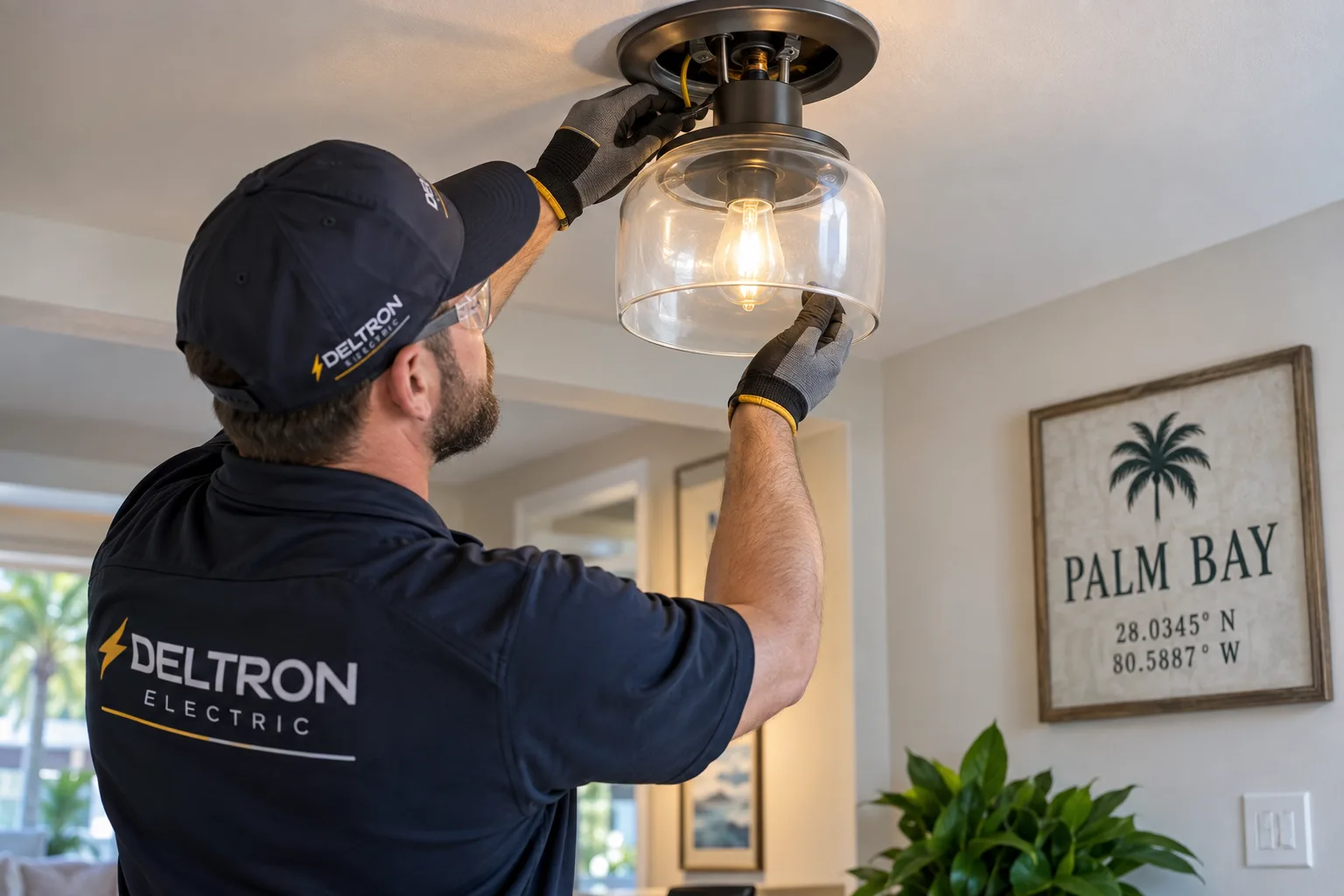
The installed fixture, lamp, LED driver, and dimmer must be evaluated against the relevant manufacturer instructions. Those instructions help determine lamp limits, enclosure restrictions, insulation clearances, compatible controls, and whether a component is intended to be serviced.
Where product identification is missing or heat damage makes the equipment unsuitable for reuse, replacement may be more appropriate than attempting a component repair. A matching appearance alone does not establish that a replacement is electrically suitable.
5. Explain the repair limits and restoration plan
Light fixture electrical repair may involve a new fixture, replacement of damaged connectors or conductors, correction of an incompatible dimmer, or repair of a defective supply connection. More extensive damage can require wiring replacement and access through a ceiling or wall.
Electrical repair does not automatically include roof repair, drywall restoration, insulation replacement, or smoke cleanup. If moisture or building damage contributed, those issues need coordination so they do not compromise the electrical repair.
For wiring alterations or a larger repair scope, current permit and inspection requirements should be confirmed with the City of Palm Bay Building Department. Not every fixture repair has the same requirements. Ask what approvals apply to the proposed work and who will handle them.
Before leaving the circuit in normal service, the electrician should explain what was repaired, what was tested, and whether any restrictions remain. An assessment of the affected circuit is not automatically a certification of every electrical component in the building.
Palm Bay Repair FAQs: Timing, Cost, and Property-Manager Coordination
Should I call 911 or an electrician first if my light fixture is smoking?
Call 911 first, from outside or another safe location. Get occupants out and stay out. An electrician can diagnose the fixture and circuit after emergency responders address the immediate hazard. Do not wait for a contractor callback while deciding whether smoke is serious.
If the smoke stops when I turn off the light, can the repair wait until business hours?
Not on that fact alone. Stopped smoke does not rule out smoldering material or damaged energized wiring. If the incident has not been assessed, contact 911 from safety and explain that the fixture smoked but has stopped.
After emergency assessment and appropriate circuit isolation, a business-hours repair may be reasonable if no remaining hazard or essential-service need requires faster action. Keep the affected circuit out of use until an electrician evaluates it; do not rely on the wall switch alone.
Why would a light fixture smoke without tripping the circuit breaker?
A loose connection or failing fixture component can create intense localized heat without enough overall current to trip a standard breaker. Protective devices have specific functions and limitations. The absence of a trip does not override visible smoke, a burning odor, or heat damage.
Can replacing the bulb or fixture fix the problem, or does the wiring need inspection?
A replacement may be part of the repair, but the connection point and affected wiring need evaluation too. A new fixture connected to heat-damaged conductors can leave the underlying hazard unresolved. The electrician determines whether damage is confined to a replaceable component or extends into the box, controls, or branch circuit.
What affects the cost and timing of a smoking light fixture repair in Palm Bay?
Important factors include the cause of failure, extent of conductor damage, ceiling height, access above the fixture, fixture type, availability of approved parts, and whether multiple locations need testing. Water intrusion, utility involvement, permit requirements, and building access can also affect the schedule.
A straightforward fixture replacement is different from tracing an intermittent fault or replacing damaged wiring above a finished ceiling. Ask how diagnostic work is priced, what the repair estimate includes, and whether additional access or restoration is excluded. A reliable scope requires more than a description of the fixture’s appearance.
What should a renter or property manager prepare?
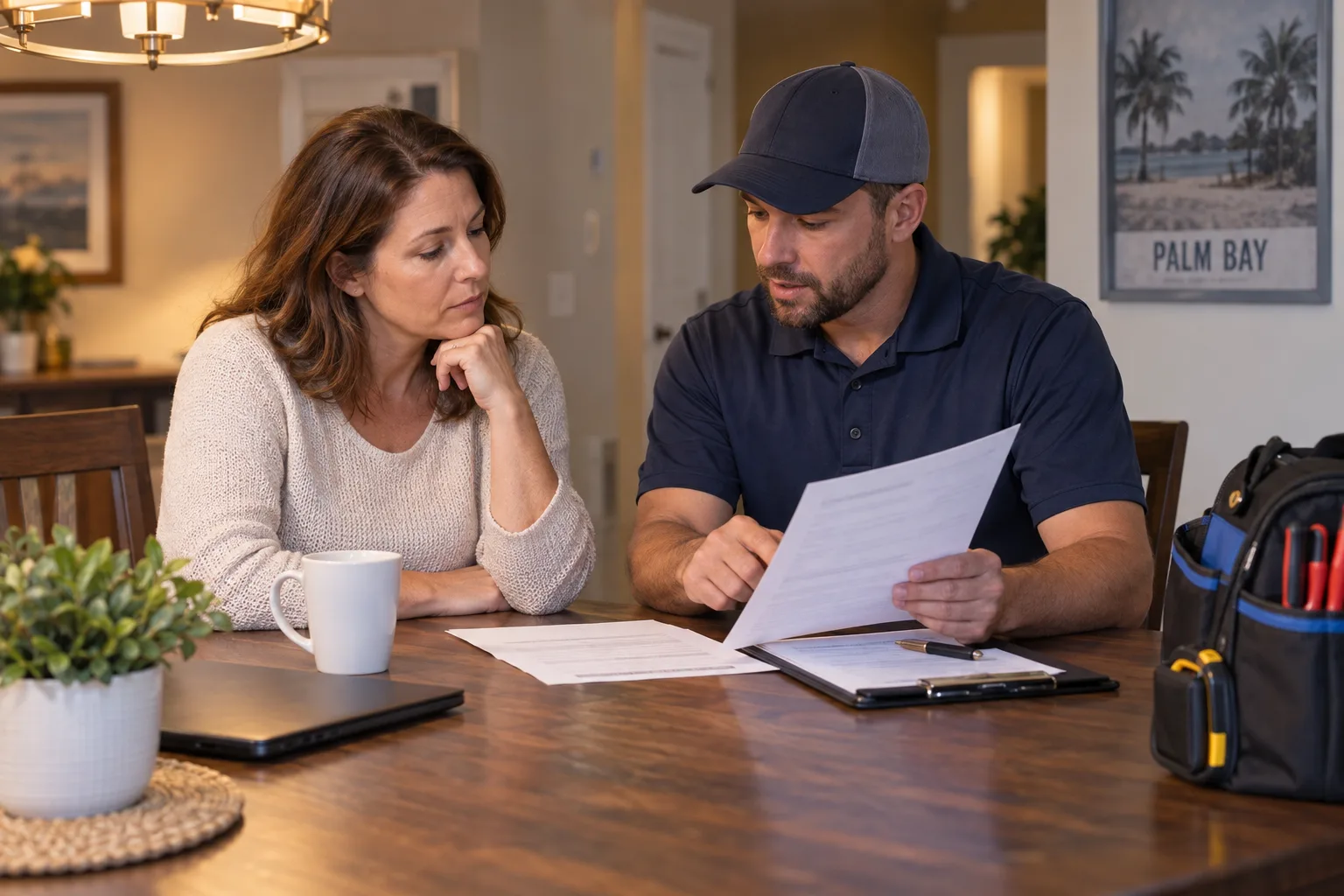
After emergency needs are handled, establish who authorizes repairs and who provides access. Share the unit number, room location, responder instructions, and any restrictions on occupancy or electrical use. In a condo, access above a ceiling or to shared electrical areas may require association coordination.
Managers should communicate clearly that the affected fixture and circuit must not be tested by occupants or maintenance staff. Preserve any observations or photos already available, but never ask someone to approach the hazard to improve documentation. Repair records should distinguish the electrical work from separate building restoration.
What about commercial properties with a partial outage?
Whether operations can continue depends on what the outage affects, not simply whether some outlets still work. Loss of required exit lighting, alarms, critical equipment, or safe access can make continued occupancy inappropriate. Follow responder instructions and applicable building procedures.
Do not run extension cords through exits or improvise power to bypass an isolated circuit. The electrical contractor, property operator, and any relevant authority need to coordinate restoration when life-safety systems or shared building services are involved.
How should I choose an electrician for this problem?
Choose a contractor who treats smoke damage as a diagnostic issue rather than promising that a quick fixture swap will solve it. Ask whether the evaluation includes the fixture connections and affected circuit, how additional findings are communicated, and how permit or utility coordination will be handled if necessary.
When comparing an electrician in Palm Bay, focus on a clearly explained repair scope and safe restoration process. Confirm scheduling directly rather than assuming immediate availability. Deltron Electric’s electrical service in Palm Bay includes troubleshooting and repair discussions for problems affecting household lighting and power.
After the Emergency: Arrange Diagnosis Before Using the Circuit Again
The safe sequence is straightforward: protect occupants, have the immediate fire concern addressed, keep the affected equipment out of use, and arrange professional diagnosis. Neither a stopped odor nor an untripped breaker skips a step in that sequence.
When you are safely able to discuss the repair, share only what you already observed:
- Which room and fixture were involved.
- Whether you noticed smoke, odor, flickering, buzzing, or visible discoloration.
- Whether other lights or outlets lost power at the same time.
- Any known recent lamp changes, remodeling, ceiling work, or water leaks.
- What emergency responders said about access and power.
- Whether the property is occupied, rented, association-managed, or used commercially.
You do not need to recreate the fault, approach the fixture, remove anything, or gather new photographs. Your existing observations help direct the diagnostic conversation without exposing anyone to another incident.
After emergency responders have addressed any immediate fire hazard, call Deltron Electric at (833) 335-8766 to discuss the affected fixture and circuit and schedule electrical diagnostics and repair in Palm Bay. Ask what evaluation is needed before either is used again, so the next step addresses the cause—not just the light that went out.