


What Cocoa Beach Homeowners Should Confirm Before Hiring an Electrician for a Panel or Service Upgrade
A panel or electrical service upgrade is not a project to compare by the bottom-line number alone. For Cocoa Beach and Merritt Island homeowners, the useful question is: does each electrical estimate describe the same safe, permit-ready scope of work? A low initial number may exclude equipment, repairs, permit handling, service changes, or site conditions that another estimate addresses from the beginning.
Whether you are planning a new appliance, EV charger, generator connection, RV outlet, home addition, rewiring project, or replacement panel, a clear estimate makes the decision easier. It should show what the electrician inspected, what equipment is included, what is excluded, and which items cannot be confirmed until access or utility requirements are reviewed.
What a Complete Electrical Estimate Should Tell You
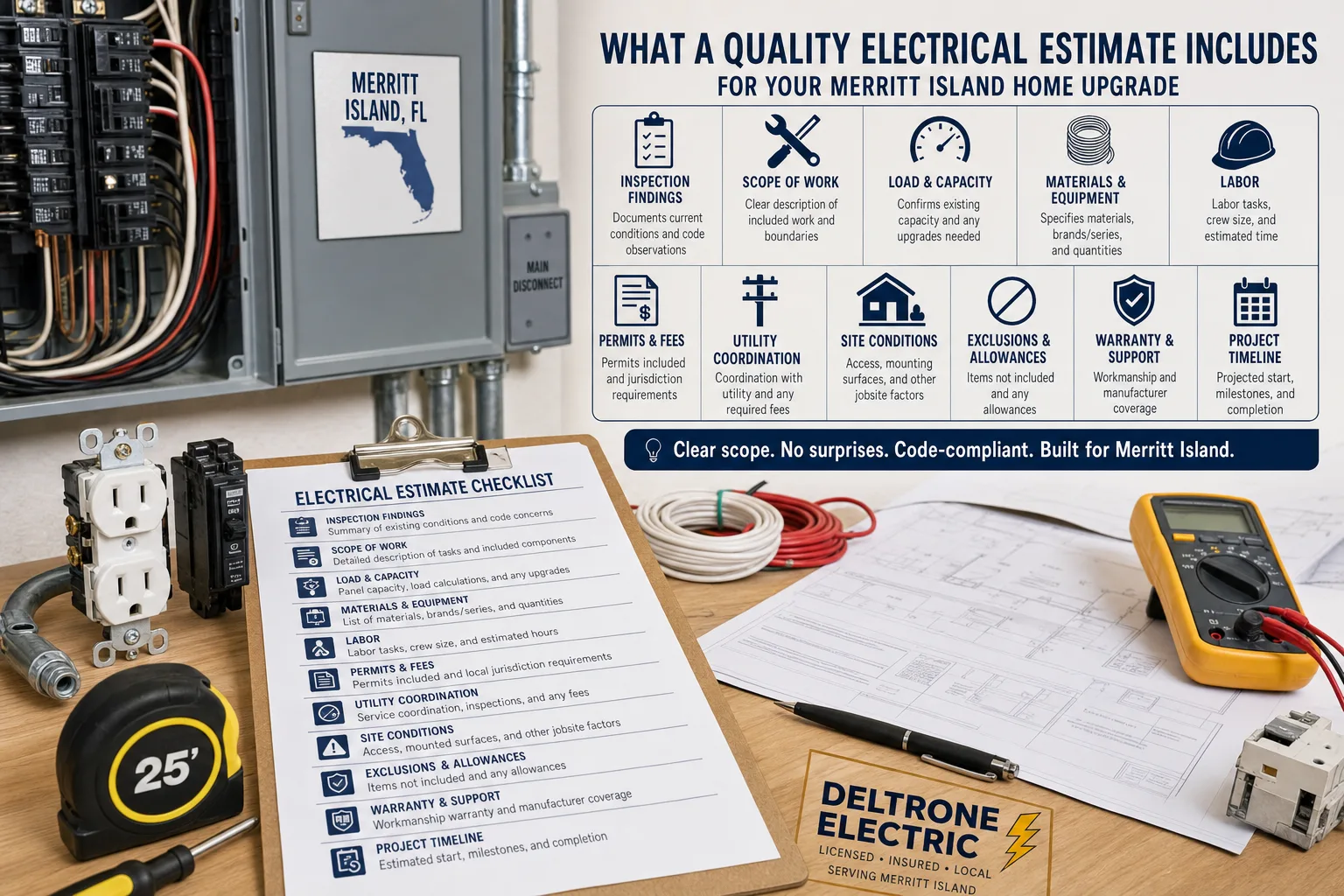
A complete electrical estimate Merritt Island property owners can meaningfully compare is more than a total price and a short description such as “upgrade panel.” It should identify the problem or goal, the intended work, and the conditions on which the price is based.
For example, a homeowner may ask for a panel upgrade because breakers are full. But the appropriate scope could range from adding a properly sized subpanel to replacing the main panel, upgrading the service equipment, correcting grounding or bonding concerns, or reviewing whether the existing service has adequate capacity for planned loads. Those are different projects with different material, labor, permitting, and utility implications.
Before approving an estimate, look for these basics:
- Project purpose: A description of why the work is being considered, such as accommodating an EV charger, adding circuits for an addition, replacing damaged equipment, preparing for a generator, or addressing an overloaded panel.
- Equipment scope: Whether the proposal includes a panel, main breaker, service disconnect, meter-related equipment, subpanel, breakers, surge protection, grounding components, or branch circuits.
- Labor scope: Removal of existing equipment, installation, circuit labeling, testing, reconnection work, and cleanup where applicable.
- Permit and inspection responsibilities: Who will obtain the permit, schedule inspections, and respond if an inspector requires a correction.
- Known exclusions: Work not included in the price, such as drywall repair, trenching, painting, utility-owned equipment work, or repairs to concealed wiring unless specifically listed.
- Allowances or site-dependent items: Work that may be needed but cannot be confirmed until equipment is opened, walls are accessed, or utility requirements are determined.
- Schedule considerations: Expected work sequence and factors that may affect timing, including permit processing, inspections, material availability, and utility coordination.
A good estimate does not need to pretend every unknown condition has already been solved. It should clearly separate the firm scope from the items that depend on findings. That distinction helps prevent a homeowner from treating an allowance as a guaranteed final price.
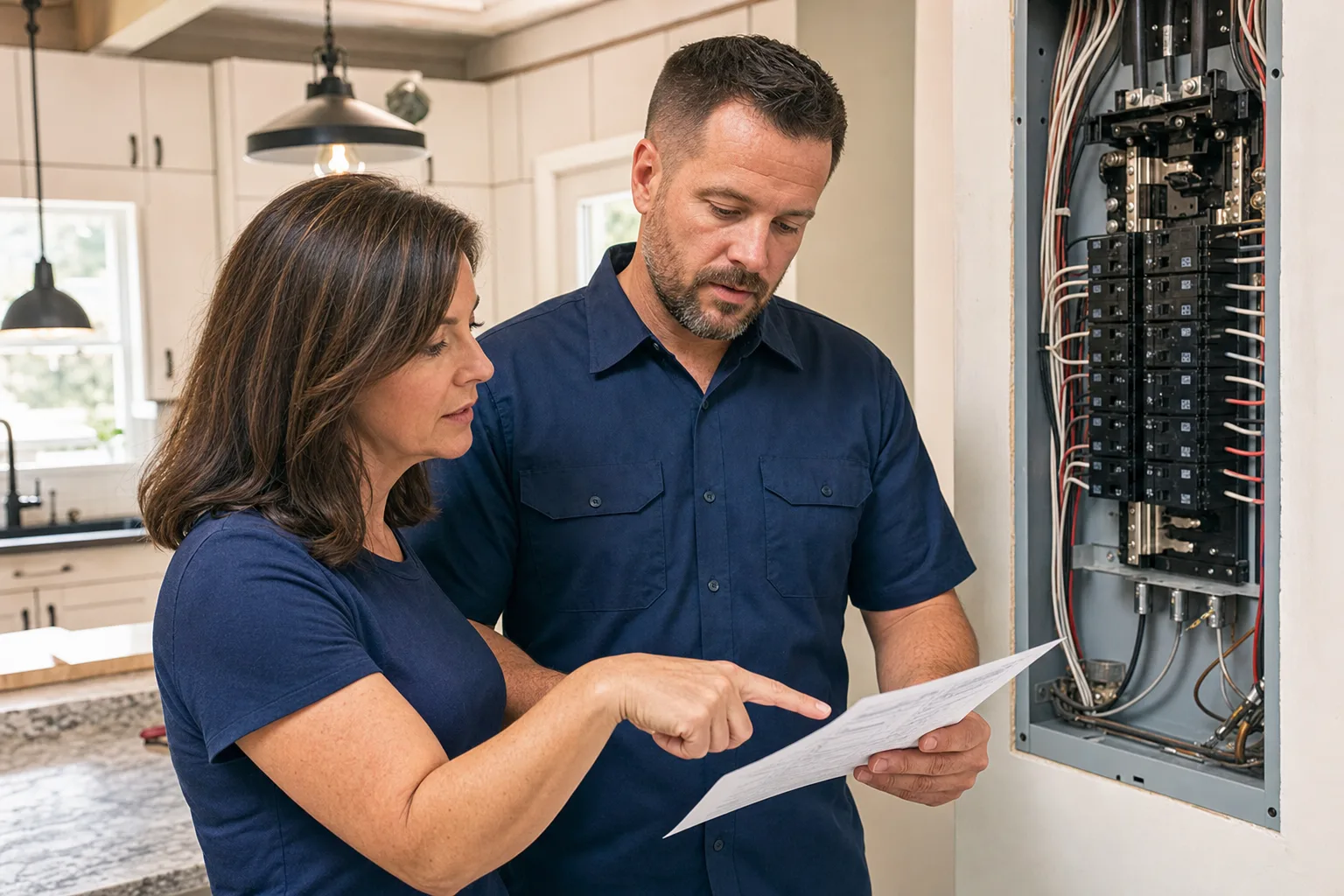
Is the Estimate Based on an On-Site Inspection and Load Review?
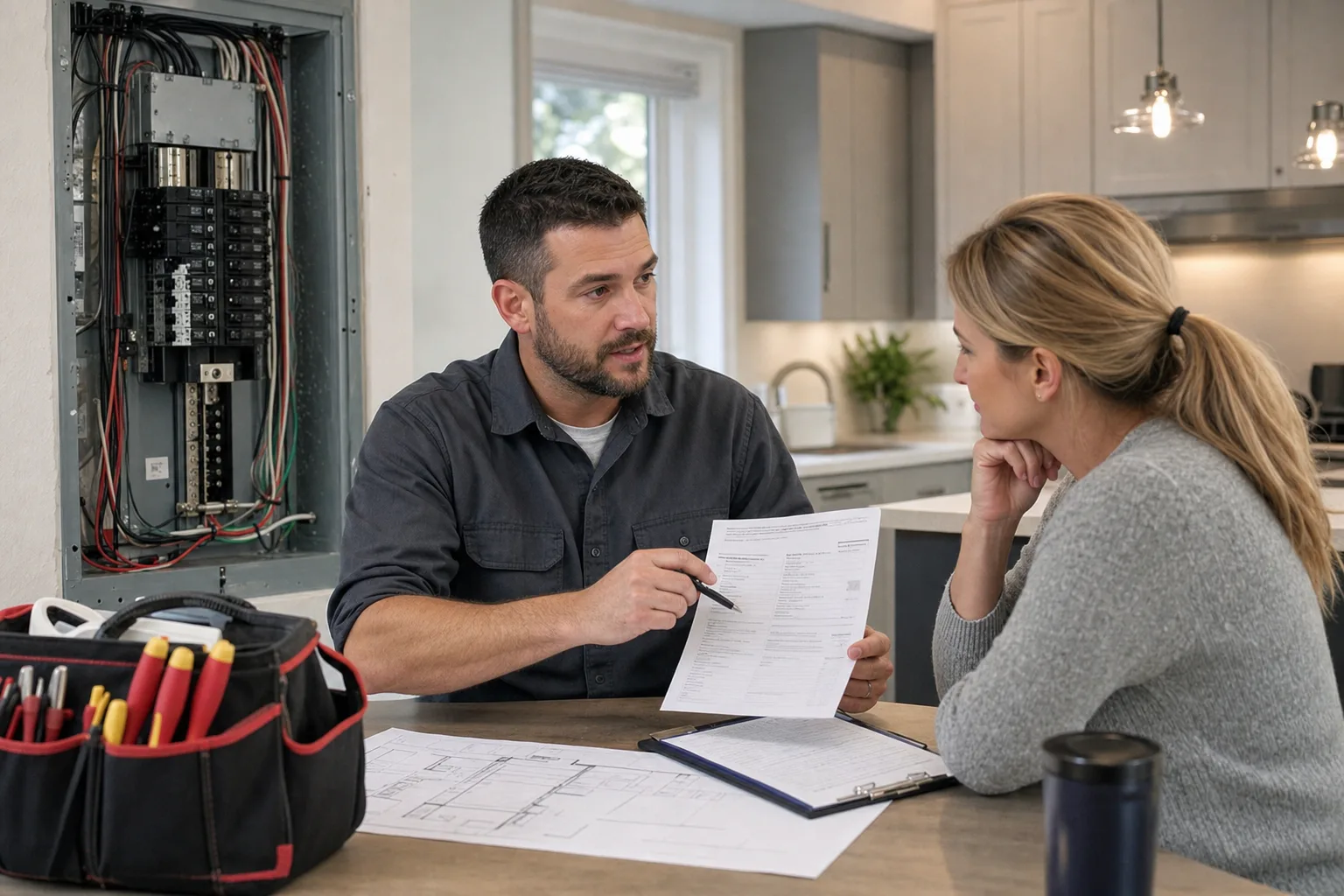
For a panel, service, generator, appliance, addition, or EV charger electrical upgrade estimate, an on-site review is usually more reliable than a rough phone description. Photos can be useful for initial scheduling, but they may not reveal the condition of panel interiors, circuit routing, grounding components, equipment clearances, access limitations, corrosion, or the actual electrical demands of the property.
What an On-Site Review Should Consider
An electrician evaluating a Merritt Island or Cocoa Beach upgrade should review the existing equipment and the proposed loads. This often includes the panel and breakers, service equipment, available circuit spaces, conductor condition where visible, grounding and bonding components, equipment location, and access for installation.
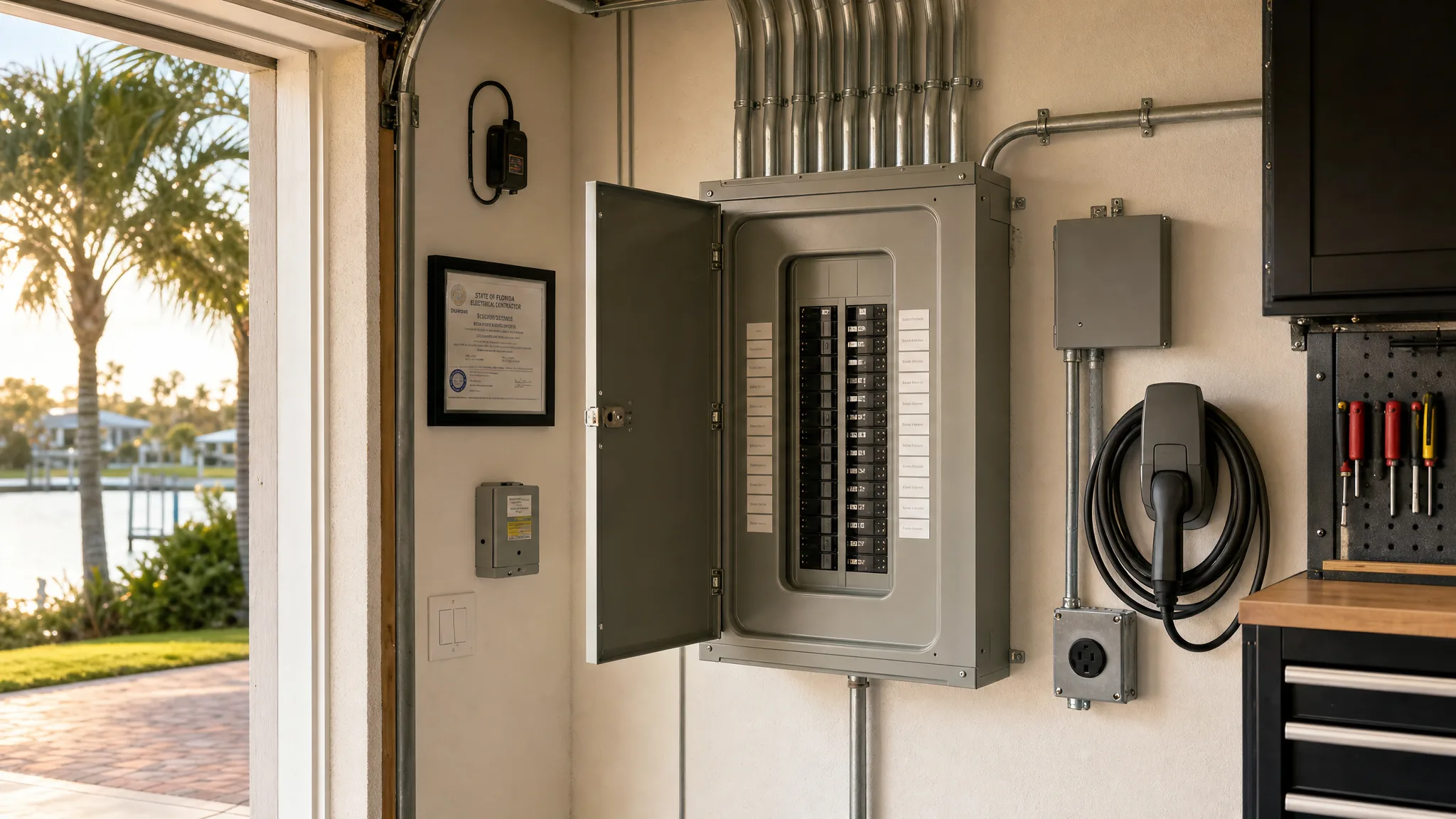
For a capacity-related project, the review should also account for major existing and planned loads, which may include air conditioning, electric heat, water heating, range or cooktop equipment, dryers, pool equipment, workshop loads, generators, RV receptacles, and EV charging. A formal or documented electrical load calculation is especially important when the question is whether the current service can support a new large appliance or charging load.
A panel with open breaker spaces is not automatically a panel with sufficient electrical capacity. Conversely, a crowded panel does not automatically require a complete service replacement. The answer depends on the equipment condition, circuit needs, load calculation, code requirements, and the specific upgrade being planned.
For planning purposes, review Deltrone Electric’s guidance on electrical capacity for new appliances or a future EV charger. It can help frame the questions to ask before accepting an EV charger electrical upgrade estimate.
When a Phone Price Is Not Enough
Schedule an inspection rather than relying on a rough price when any of the following apply:
- You are adding an EV charger, generator inlet or transfer equipment, RV outlet, induction range, heat-pump water heater, hot tub, pool equipment, or another substantial load.
- The panel is old, damaged, crowded, showing corrosion, or has breakers that trip repeatedly.
- You are planning an addition, garage conversion, major remodel, or room rewiring.
- The scope may involve a main breaker, service disconnect, meter location, or utility service conductors.
- There are signs of heat, water intrusion, damaged wiring, flickering throughout the home, or inconsistent power.
- A commercial owner or property manager needs to evaluate tenant loads, equipment additions, common-area work, or access constraints.
An in-person inspection is not a promise that no concealed condition will ever be found. It is the practical step that allows the electrician to base the proposal on visible facts rather than assumptions.
What Work Scope, Materials, and Labor Should Be Itemized?
When comparing a panel upgrade estimate, ask each electrician to make the scope readable. You do not need every connector listed individually, but you should be able to tell what major equipment, circuit work, and labor activities are included.
Panel and Service Equipment
The estimate should clarify whether it includes replacement or installation of any of the following:
- Main electrical panel or load center
- Main breaker or service disconnect
- Subpanel and feeder
- New breakers, including GFCI or AFCI protection where required for the work
- Grounding and bonding components
- Whole-home surge protection, if selected or required within the stated scope
- Panel directory labeling and circuit identification
- Weather-rated exterior equipment, if the installation is outdoors
In coastal areas such as Cocoa Beach and Merritt Island, exterior equipment condition deserves careful attention. Salt air, moisture, wind-driven rain, and aging enclosures can affect disconnects, outlet boxes, panel components, conduit fittings, and covers. If outdoor equipment is part of the project, the estimate should say whether it includes repair or replacement of corroded or weather-compromised items discovered during inspection.
New Circuits and Branch Wiring
For an appliance, EV charger, generator, RV outlet, or addition-related project, confirm whether the price includes the complete branch-circuit path—not merely the connection point. Ask about circuit routing, conductor type and size, breaker type, conduit where needed, wall or ceiling access assumptions, and the exact endpoint to be served.
For example, an EV charger estimate may include a dedicated circuit and receptacle or hardwired connection at a particular garage location. It may not include extensive drywall restoration, long underground runs, structural modifications, or relocation of obstacles unless those items are written into the proposal. The same principle applies to generator equipment: clarify whether the estimate covers only the electrical connection or also transfer equipment, inlet equipment, selected-circuit changes, and any required service modifications.
For background on equipment choices, see these electrical panel replacement options and Deltrone Electric’s information on electrical panel installation and upgrade planning.
Questions to Ask About Labor and Access
Labor pricing is shaped by more than the number of breakers being installed. Ask whether the proposal accounts for:
- Safe shutoff, removal, replacement, reconnection, testing, and labeling
- Work performed in a garage, utility room, exterior wall, attic, crawlspace, condo utility area, or commercial electrical room
- Restricted access, tenant coordination, parking limitations, gate access, or association requirements
- Equipment clearance work or relocation required to create a safe working area
- Work during a utility outage window, if a service-related change requires it
- Whether patching, paint, landscaping, concrete repair, or other non-electrical restoration is included or excluded
These questions are not an attempt to force a contractor into predicting every hidden condition. They help make the assumptions visible so that competing estimates can be compared fairly.
When Permits, Inspections, and Utility Coordination Belong in the Estimate
Panel and service upgrades commonly involve electrical permit and inspection requirements. The proposal should say whether permit fees are included, estimated separately, or excluded. It should also identify who is responsible for submitting the permit application, arranging inspection access, and completing corrections if an inspection identifies work needed within the contractor’s scope.
Property owners should confirm current requirements with the applicable local authority. For Merritt Island projects, Brevard County Building Code Services is a useful starting point for local process information. Requirements can vary by project type, jurisdiction, property conditions, and whether a service alteration is involved.
Utility coordination can also affect both price and timing. If work changes service equipment or requires the power to be disconnected and restored, the electrician may need to coordinate with the serving utility. The utility controls its own equipment and scheduling process, so an electrician should not promise a service restoration time that depends entirely on another party.
Ask these direct questions:
- Is permit application and permit fee handling included in this estimate?
- Are required inspections included, and who schedules them?
- Does this scope require utility notification, disconnection, reconnection, or equipment review?
- What work is the utility responsible for, and what work is the electrician responsible for?
- Will my home be without power during part of the project, and what is the expected sequence?
- Are homeowner association or condominium approvals needed before exterior equipment, meter-area work, or routing changes begin?
For condominiums, rental properties, and commercial locations, the owner or manager may also need to coordinate building access, tenant notices, electrical-room access, and association or landlord approval. Those administrative details should not be left until the work date.
What Can Change the Final Price After Work Begins?
A responsible estimate should identify foreseeable change factors without presenting them as inevitable add-ons. Some conditions can only be found after equipment is opened or access is gained. In older homes and coastal properties, that may include corrosion behind an exterior enclosure, deteriorated conductors, damaged conduit, improper prior alterations, inaccessible splices, or wiring that does not match what was visible at the panel.
Common site-dependent cost factors include:
- Hidden damage, corrosion, overheating, or water intrusion affecting existing equipment
- Insufficient or deteriorated wiring that must be corrected to safely connect the new equipment
- Unexpected circuit tracing or identification work
- Longer-than-assumed routing through attics, walls, garages, or exterior pathways
- Trenching, underground conduit, concrete cutting, or restoration requirements
- Required relocation of equipment because of clearance, accessibility, or condition concerns
- Utility requirements that alter the service-side work or timing
- Permit or inspection requirements that expand the verified scope
Ask How Change Orders Will Be Handled
Before work begins, ask the electrician what happens if a material issue is discovered. A sound process is to explain the finding, describe why it affects safety or code compliance, provide the added scope and cost in writing, and obtain approval before proceeding with work beyond the original agreement whenever circumstances allow.
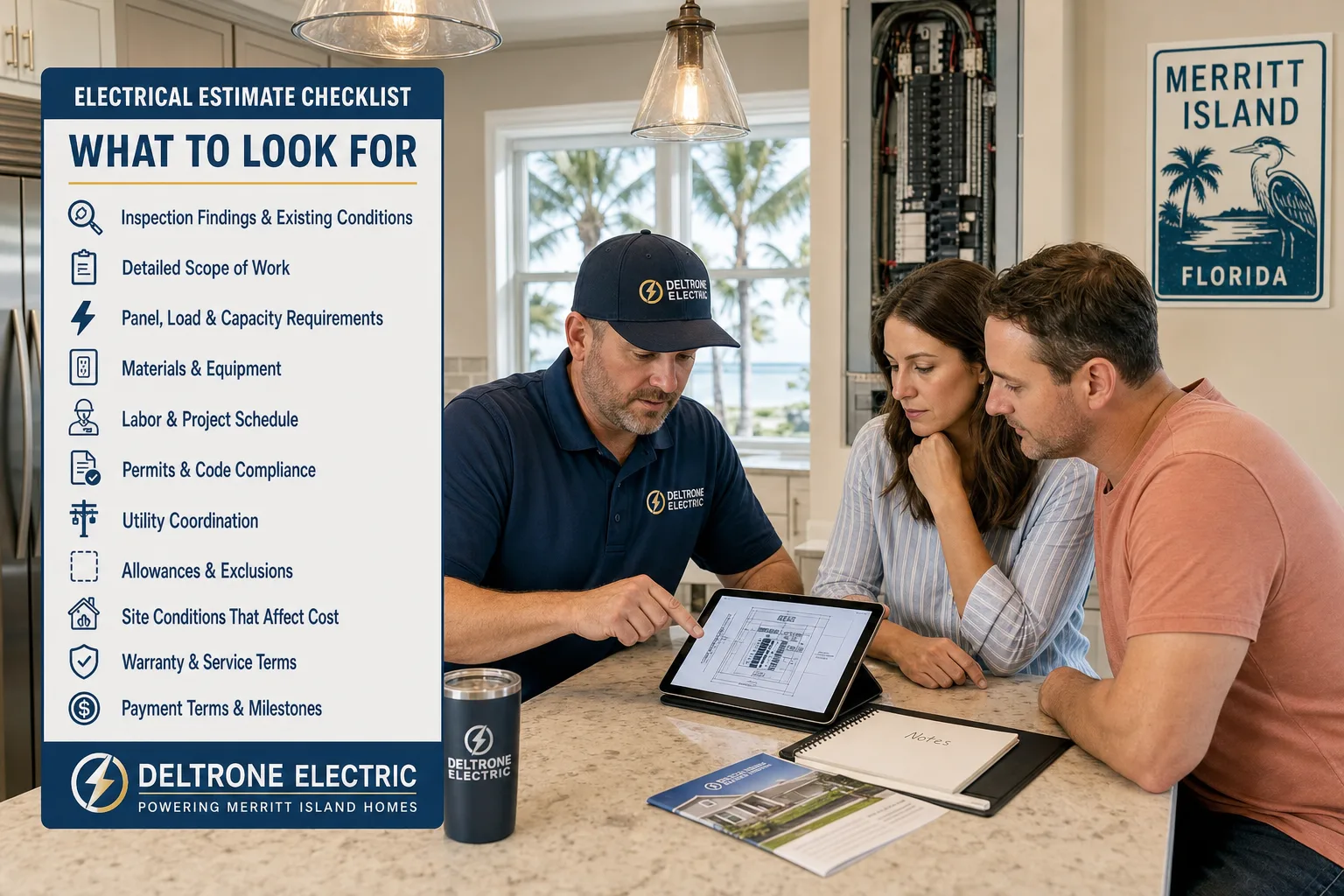
A change order should identify the condition found, the additional work, materials or labor involved, price impact, and any schedule impact. This protects both the property owner and the contractor. It also makes it easier for property managers and commercial owners to document authorization decisions.
How to Compare Two Electrical Upgrade Estimates Fairly
Put the estimates side by side and compare scope first, then price. A less expensive proposal may be appropriate if it genuinely includes the same work and assumptions. It is not a valid comparison if one estimate covers a panel only while another includes service equipment, permits, grounding corrections, new circuits, surge protection, inspection coordination, and utility-related planning.
Use This Comparison Checklist
- Confirm the starting condition. Did both electricians inspect the same equipment and identify the same issue or project goal?
- Compare capacity assumptions. Does each estimate address the same current and future loads, especially for an EV charger, generator, induction cooking, water heating, or addition?
- Match equipment descriptions. Are both proposals replacing the same panel, main breaker, disconnect, subpanel, breakers, and protective devices?
- Compare circuit work. Is the number of new circuits, route length assumption, endpoint, and wiring method equivalent?
- Check permits and inspection handling. Do both include the same responsibilities and fees?
- Read exclusions carefully. Note drywall, paint, trenching, access changes, concealed-condition repairs, utility work, and other items that may not be included.
- Ask about allowances. Find out what is a firm price and what is an estimated amount subject to site conditions.
- Verify contractor credentials. Confirm Florida licensing status through the Florida Department of Business and Professional Regulation and ask for current insurance information before hiring.
It is also reasonable to ask how the contractor will protect the property, label the completed work, test circuits, and explain shutdown timing. A clear response often tells you more about project planning than a one-line quote does.
If the upgrade is being considered because of dimming lights or equipment behavior, distinguish a planned upgrade from a possible repair issue. For example, review these garage lighting and voltage-drop warning signs if lights dim when a garage door operates. An inspection may reveal a connection, circuit, or service concern that should be diagnosed before a capacity project is priced.
When a Merritt Island Electrical Upgrade Should Be Treated as Urgent
Many upgrades can be planned during normal service hours, especially when the goal is future EV charging, an appliance replacement, a remodel, or added circuit capacity. However, certain symptoms deserve prompt electrical inspection rather than waiting until several estimates are collected.
Arrange prompt professional attention if you notice:
- A hot panel cover, hot breaker, hot outlet, or hot switch
- Burning odor, smoke, buzzing, crackling, discoloration, or visible arcing
- Water entering or collecting around electrical equipment
- A breaker that trips repeatedly, will not reset, or has obvious heat damage
- Widespread flickering, severe dimming, intermittent power, or unusual changes after storms
- Damaged exterior service equipment, loose components, or signs of corrosion compromising an enclosure
If there is active smoke, fire, sparking, or an immediate threat to people or property, move to a safe location and call emergency services. Do not remove a panel cover or attempt to reset damaged equipment yourself.
Frequently Asked Questions
Should an electrical estimate for a panel or service upgrade include a load calculation?
When the project involves new major loads or a question about available capacity, the estimate should state whether a load calculation or capacity review is included. This is particularly important for EV chargers, generators, electric appliance upgrades, additions, RV outlets, and commercial equipment. The calculation helps determine whether the planned load can be supported and whether panel, feeder, or service work is necessary.
Why can two electrical estimates for the same Merritt Island home be so different?
The estimates may not cover the same scope. Differences often come from the type of panel or service equipment included, number of circuits, routing difficulty, permit handling, grounding work, surge protection, access conditions, utility coordination, restoration exclusions, and whether each contractor has inspected the property. Ask each electrician to explain what is included and excluded instead of assuming two similar project titles mean the same work.
Does an electrical estimate normally include permits, inspections, and utility coordination?
It depends on the contractor and the project. A clear estimate should state whether permit fees, permit processing, inspection scheduling, and utility coordination are included, excluded, or billed separately. Do not assume these items are included simply because a proposal mentions a panel or service upgrade.
What exclusions or possible added costs should I ask an electrician to explain before approving an estimate?
Ask about concealed damage, corroded equipment, wiring repairs, drywall or paint restoration, trenching, concrete work, long circuit runs, equipment relocation, permit fees, utility requirements, and access limitations. Also ask which items are firm scope items and which are allowances or conditions that may require a written change order.
When should I schedule an inspection instead of relying on a rough price over the phone?
Schedule an on-site inspection whenever the work involves a panel, main breaker, service disconnect, new high-demand appliance, generator, EV charger, RV outlet, addition, recurring breaker trips, dimming, heat, water exposure, or aging equipment. A phone range may be useful for early budgeting, but it is not a substitute for reviewing the actual installation conditions.
Choose the Scope, Not Just the Number
The most useful electrical upgrade estimate gives you a practical basis for choosing: it identifies the equipment, labor, permits, inspections, access assumptions, exclusions, and conditions that could change the scope. That level of detail is especially valuable for Cocoa Beach and Merritt Island properties where outdoor exposure, older equipment, association rules, and utility coordination can affect project planning.
If you have an estimate in hand, an upgrade idea, or signs that your home may be running short on electrical capacity, what should be inspected and included before you commit to the scope? Call Deltrone Electric at (833) 335-8766 for a direct, practical next-step discussion with a qualified local electrician.