


What Happens During an Electrical Panel Replacement in Titusville?
Electrical panel replacement involves planning, a coordinated power shutdown, removal and installation by an electrician, required inspections, and restoration of service. But if your main breaker keeps tripping in Titusville, the first step is determining whether replacement is actually necessary.
A main breaker can trip because of combined electrical demand, overheating connections, damaged equipment, or a fault—not just a defective breaker. This guide explains what the symptoms may mean, what you can safely record, and how troubleshooting helps determine whether you need load management, a targeted repair, or a panel or service upgrade.
Main Breaker Tripped Again? Start With These Safety Checks
Repeated resetting is not a repair. A breaker interrupts electricity to protect against certain unsafe conditions. Restoring power without understanding repeated trips can re-energize damaged equipment or recreate an overload.
Before approaching any electrical equipment, consider what you have already noticed from a safe location:
- Smoke, flames, active sparking, or a strong burning odor: Leave the affected area, keep others away, and call emergency services from a safe location. Do not approach the panel to shut it off.
- Crackling, new loud buzzing, visible scorching, or a melted enclosure: Stop interacting with the equipment and seek urgent electrical assistance. If there is active arcing or a suspected fire, follow emergency guidance rather than scheduling a routine appointment.
- Water around electrical equipment or storm damage to the service: Stay away. Do not touch the enclosure, meter, nearby metal, or fallen wires. Contact the serving utility for damaged utility lines and emergency services when there is immediate danger.
- Some lights suddenly very bright while others dim: This can indicate a serious supply or neutral connection problem. Avoid further electrical use and seek urgent utility and electrician guidance.
- Repeated trips without visible danger signs: Leave the repeatedly tripping breaker off and arrange prompt professional troubleshooting. The absence of smoke does not establish that the equipment is safe.
Do not touch the panel to check whether it feels hot. Do not open electrical enclosures, remove covers, tighten connections, pull a meter, or attempt a main-breaker replacement. Parts of service equipment can remain energized even when the main breaker is off.
For a Titusville rental or condo, tell the owner, property manager, or association about the interruption promptly. Residents should not enter locked electrical rooms or operate shared building equipment.
Why the Main Breaker Can Trip While Individual Breakers Stay On
A branch-circuit breaker protects an individual circuit, such as one serving a dryer, air conditioner, or group of receptacles. A main breaker protects the service or feeder supplying multiple circuits, depending on the property’s electrical arrangement.
That distinction explains one common situation: the main breaker trips but individual breakers stay on because several circuits together create excessive demand, while none individually exceeds its own breaker’s operating limits.
For example, a Titusville household may have the air conditioner, electric dryer, water heater, oven, and EV charger operating at the same time. Each circuit might be functioning within its own limits, but their combined demand could exceed what the service can support.
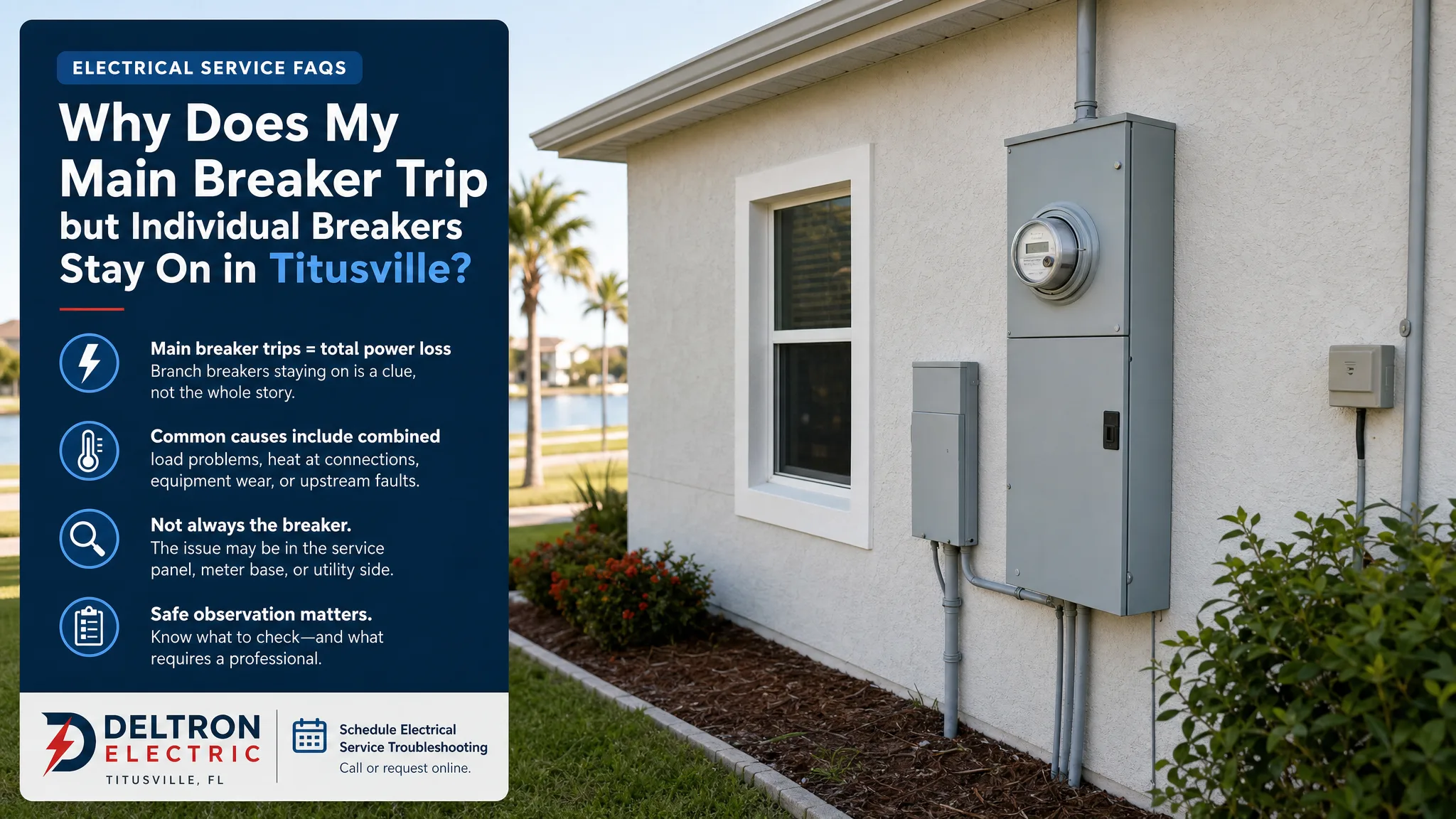
However, overload is only one possibility. A damaged connection near the main can create localized heat. Certain faults can cause the main to open without a branch breaker opening first; breakers do not always provide perfectly coordinated operation.
A whole-property outage does not prove the main tripped
A utility interruption, damaged service connection, upstream disconnect problem, or shared-building electrical issue can also shut off power. Some properties have an outdoor main disconnect separate from the indoor panel.
If you can safely see the breaker position without opening or approaching suspect equipment, record it. Otherwise, simply report that the property lost power. Check your utility’s outage information using a phone, and note whether neighboring properties or condo common areas also lost power. Do not go looking for energized equipment to confirm the cause.
Common Causes: Combined Loads, Connection Heating, and Breaker Problems
Combined demand exceeds available capacity
When a main breaker trips under heavy load, an electrician will consider the property’s simultaneous electrical demand. Long cooling cycles during Titusville’s hot weather can overlap with cooking, laundry, pool equipment, or charging equipment. A small commercial property might experience a similar overlap among air conditioning, refrigeration, and workshop machinery.
The answer is not automatically a larger main breaker. Its rating must be appropriate for the panel, conductors, and complete service arrangement. Adding a larger breaker without evaluating those limits can create a serious hazard.
Depending on the findings, a solution may involve correcting a malfunctioning appliance, managing approved controllable loads, or upgrading service capacity. A dedicated circuit can address a branch-circuit problem, but it does not create additional capacity at the main.
Heat develops at a damaged connection
A loose, corroded, or deteriorated connection can generate concentrated heat even when overall demand does not appear unusually high. That heat can affect breaker operation and damage terminals, insulation, or the panel’s internal distribution components.
Outdoor service equipment on the Space Coast deserves attention to moisture intrusion, enclosure condition, and corrosion. Exposure is a reason to inspect—not proof that corrosion caused a particular trip.
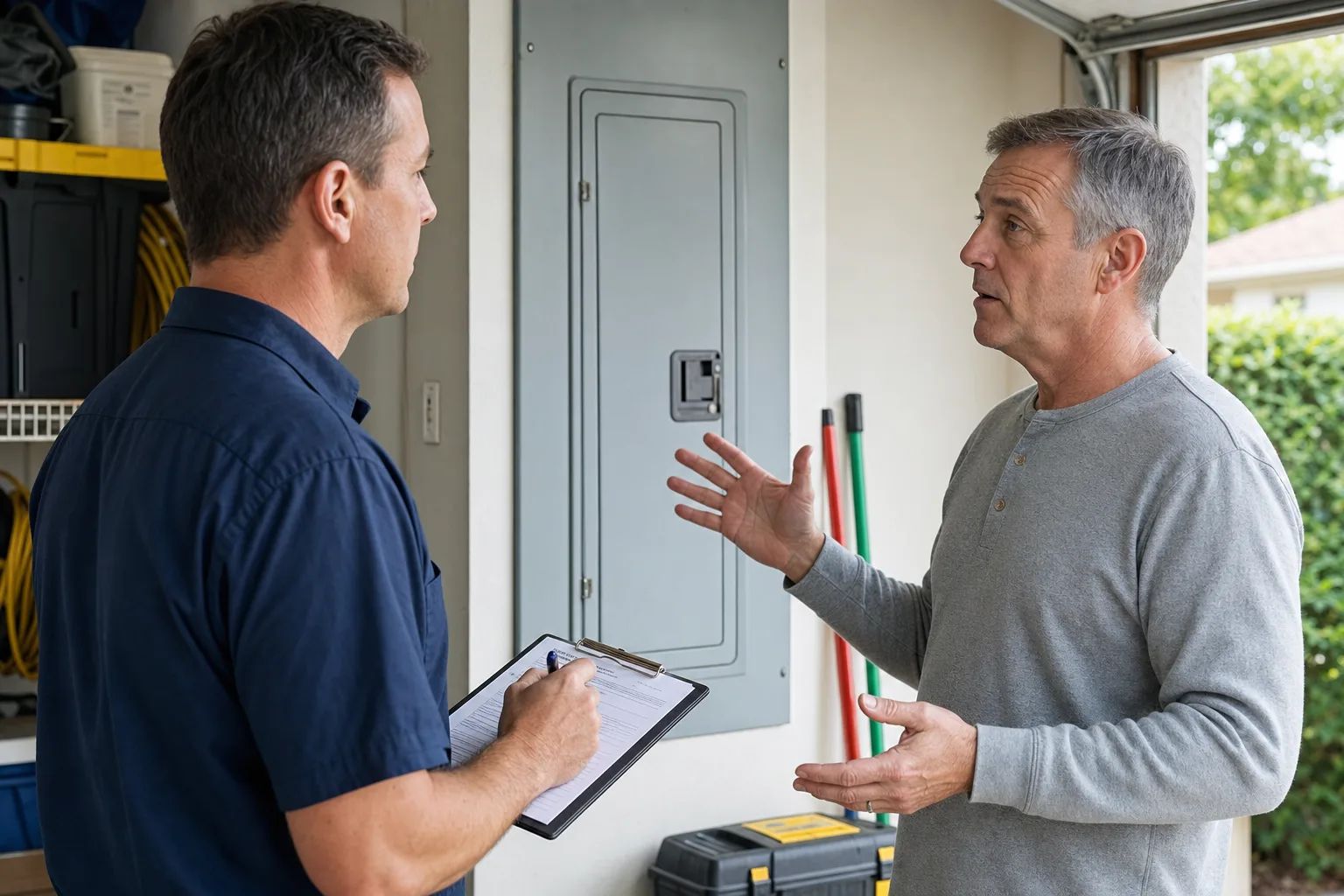
Connection damage may require replacement of affected components or conductors. Simply tightening something is not necessarily an adequate repair once heat damage has occurred, and it is not homeowner work.
The breaker or panel has deteriorated
A main breaker can develop mechanical or internal problems. The panel may also have damaged bus connections, water damage, incompatible components, or other deterioration that affects safe operation.
Breaker compatibility depends on the specific panel and approved application. A breaker that physically fits is not automatically acceptable. The electrician should check equipment labels and manufacturer documentation before selecting a replacement.
A fault or supply-side problem needs investigation
Damaged wiring, failed equipment, moisture-related faults, and problems in service conductors can create symptoms that resemble a simple breaker issue. Utility-side problems can cause outages without a main-breaker trip at all.
Storm timing is worth recording, but a trip after lightning does not confirm surge damage. Understanding what whole-home surge protection does can help with future protection planning; surge protection does not correct overloads, damaged connections, or a failing main breaker.
What Trip Timing Can Tell You—and What It Cannot
The sequence of events helps narrow the investigation. It cannot establish a diagnosis on its own.
| Observed pattern | Possible explanation | What still needs checking |
|---|---|---|
| Power trips after several major appliances run together for a while. | Combined demand or heat building at a connection. | Actual current, service capacity, equipment condition, and connection integrity. |
| Power trips as one appliance starts. | Starting current, an appliance fault, or an underlying service problem. | The appliance circuit, starting behavior, and protective-device response. |
| The main breaker trips with little power use. | Automatic loads, deteriorated equipment, connection heating, or a fault. | Loads that cycle without notice, the main breaker, and the service equipment. |
| Interruptions occur during rain or after storms. | Water intrusion, damaged equipment, or a utility interruption. | Whether the breaker actually tripped and where the electrical problem originates. |
| The property loses power while the main appears to remain on. | An upstream interruption, connection failure, or utility issue. | Supply conditions and the property’s disconnect arrangement. |
Do not intentionally run the AC, dryer, and other large loads together to reproduce the failure. Do not keep resetting the main to test how long it holds. Your description of previous events is useful without creating another hazardous condition.
What to Record Safely Before the Electrician Arrives
A clear symptom history can make electrical panel troubleshooting in Titusville more focused. Use information you can gather without interacting with service equipment:
- Time and frequency: Note when the interruption happened, whether it has happened before, and approximately how long equipment had been running.
- Major loads: Record air conditioning, electric heat, dryer, range, water heater, pool pump, EV charging, workshop tools, and commercial equipment that may have been operating.
- Extent of the outage: Did everything stop, only certain rooms lose power, or lights behave abnormally before the outage?
- Weather: Note heavy rain, nearby lightning, extreme heat, or a recent utility interruption.
- Warning signs: Report odors, sounds, visible damage, or flickering already noticed from a safe location. Do not approach equipment to investigate further.
- Recent changes: Mention a new appliance, remodel, charger, generator connection, shed circuit, or recent electrical repair.
- Reset history: Tell the electrician whether someone already reset the breaker and whether it tripped again. Do not perform additional resets for the record.
- Access and authorization: Identify locked electrical areas, tenant access requirements, and any association or management approval needed.
For rental properties, collect the occupant’s account directly rather than reducing it to “the panel is bad.” For small businesses, note which equipment cycles automatically overnight or before opening.
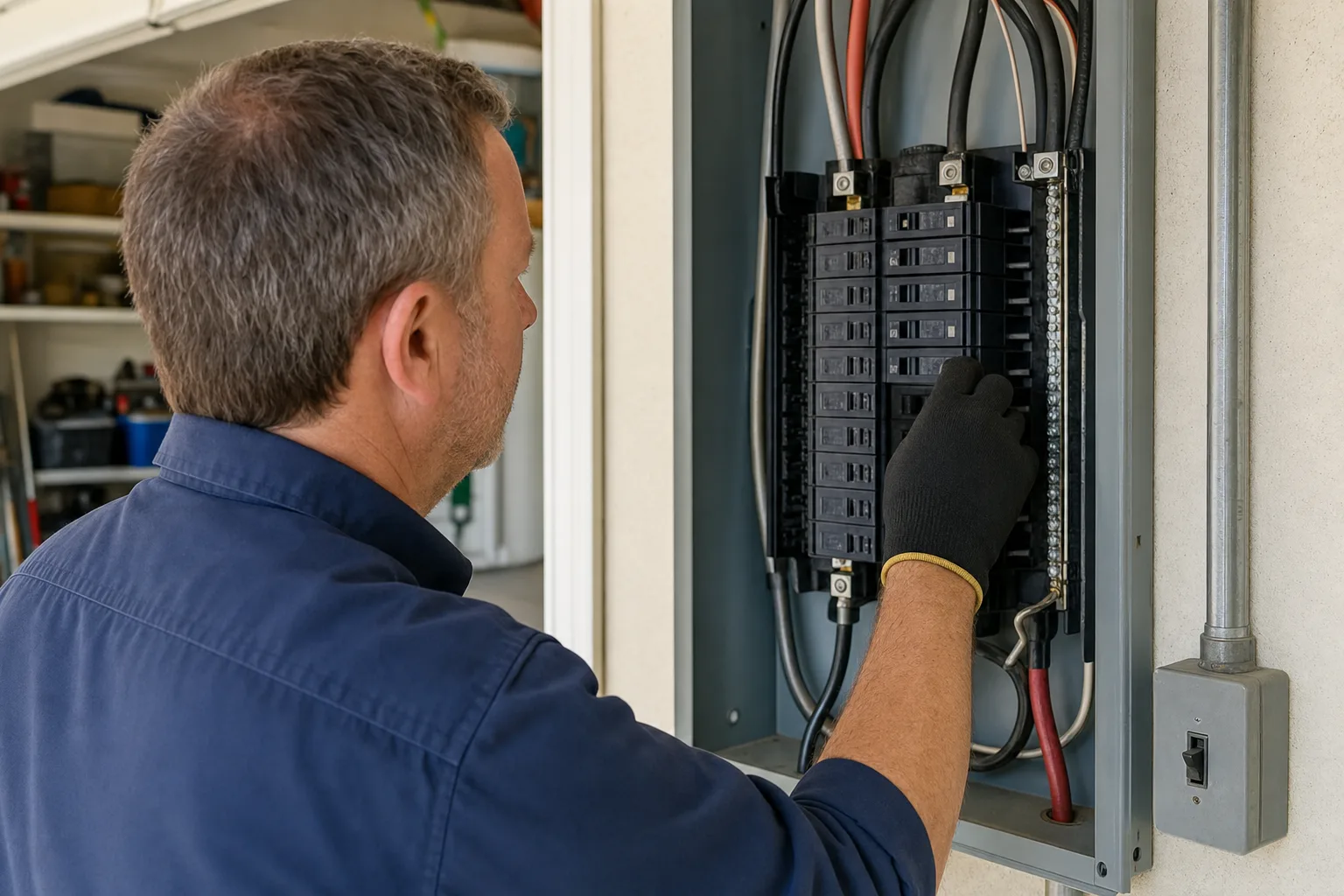
When choosing a provider for electrical service in Titusville, ask whether the visit includes investigating the reported symptoms and explaining the evidence behind repair recommendations—not just quoting a replacement.
What a Main-Breaker Troubleshooting Visit May Include
The first objective is to determine whether the installation presents an immediate hazard. Unsafe conditions may require keeping equipment de-energized until repairs and any necessary utility coordination are complete.
Depending on the symptoms and equipment, a qualified electrician’s diagnostic process may include:
- Reviewing the outage history: Comparing timing, appliance use, weather, and previous work to identify likely areas of concern.
- Identifying the service arrangement: Establishing where the main disconnect is located and whether the property has multiple panels, shared equipment, or an upstream disconnect.
- Inspecting equipment condition: Using appropriate safe-work procedures to assess damage, corrosion, moisture intrusion, conductors, terminations, and component compatibility.
- Evaluating electrical demand: Taking appropriate measurements and, where needed, performing a load calculation. One measurement during light use may not capture the conditions that caused an earlier trip.
- Assessing the breaker and supply: Comparing findings with manufacturer requirements and investigating voltage or connection concerns. Suspected utility-side issues may require the utility’s involvement.
- Explaining the findings: Separating confirmed defects from suspected causes, identifying any further testing, and recommending an appropriate repair or upgrade.
Not every intermittent problem can be confirmed during one short visit. Monitoring, appliance evaluation, additional access, or a utility investigation may be necessary. A useful diagnostic explanation states what was found, what remains uncertain, and whether the property can safely remain energized.
When a Repair Is Enough—and When Replacement or an Upgrade Makes Sense
When a targeted repair may be appropriate
A main-breaker replacement may be possible when the panel is otherwise serviceable, the manufacturer permits the replacement, a compatible part is available, and the surrounding connections have not been damaged.
Other targeted solutions could include repairing a properly identified conductor or termination problem, replacing damaged associated equipment, or correcting a fault in an appliance circuit. Any repair must address the cause and the extent of damage, not merely restore power temporarily.
When panel replacement may be justified
Replacement becomes more appropriate when there is substantial internal damage, deteriorated bus connections, compromised enclosure integrity, unavailable approved repair components, or other conditions that prevent a safe, compliant repair.
The decision between main breaker repair or panel replacement should be supported by specific findings. Age alone does not diagnose the cause of a trip, although equipment condition and parts availability matter.
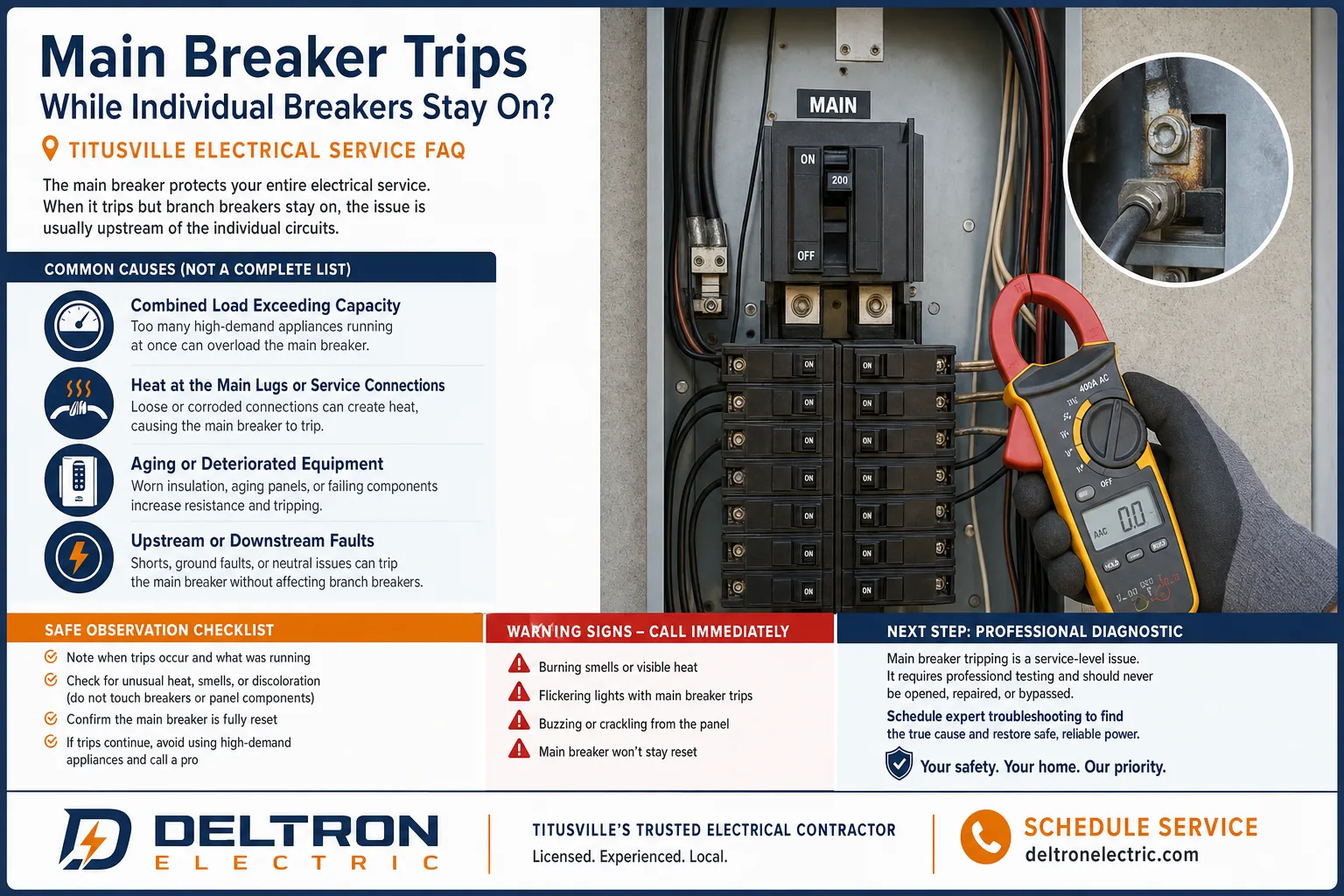
For the larger project, Deltron Electric’s information on electrical panel replacement in Titusville provides a relevant next step after troubleshooting identifies that need.
When a service upgrade is different from replacing a panel
A new panel does not necessarily increase available service capacity. An actual capacity upgrade may require changes to service conductors, meter equipment, the main disconnect, and utility facilities, depending on the existing installation.
If the service cannot support established or planned demand, the electrician can compare suitable load-management options with an upgrade. Planning for electrical panel installation in Titusville should account for both present loads and realistic future additions.
What happens if replacement is recommended?
A typical replacement project includes these stages, with details determined by the property and permitting authority:
- Scope and equipment selection: The electrician establishes whether the job is a panel replacement, a broader service alteration, or both, and selects suitable listed equipment.
- Permit and utility planning: Applicable requirements, inspections, access, and any disconnect/reconnect arrangements are established before work.
- Planned power interruption: Occupants receive instructions about the shutdown. Refrigeration, medical equipment, business operations, and shared-building systems need advance consideration.
- Removal and installation: After appropriate isolation and verification, the electrician replaces the equipment and completes required conductor, grounding, bonding, and circuit-identification work.
- Checks, inspection, and restoration: Required approvals and utility procedures are completed in the applicable sequence, followed by restoration and operational checks.
- Handoff: The owner receives an explanation of the completed work, circuit labeling, and any remaining limitations or follow-up needs.
Do not assume the entire process will fit into a particular outage window. Equipment availability, concealed damage, inspection scheduling, and utility requirements can affect restoration timing.
Titusville permitting and utility coordination
A Titusville mailing address does not by itself establish permitting jurisdiction. The contractor should confirm whether the property falls under the City of Titusville or another applicable authority, such as Brevard County for an unincorporated address.
Use the City of Titusville’s official website or Brevard County’s official website to reach the appropriate building department and confirm current requirements for the actual scope. Do not assume that a breaker-only repair and a complete service alteration follow identical procedures.
The serving utility must also confirm any required service isolation, reconnection, and responsibility boundaries. For an FPL-served property, use FPL’s official outage and electrical service resources; otherwise, contact the utility listed on the electric bill. Meter and service work must not be treated as homeowner tasks.
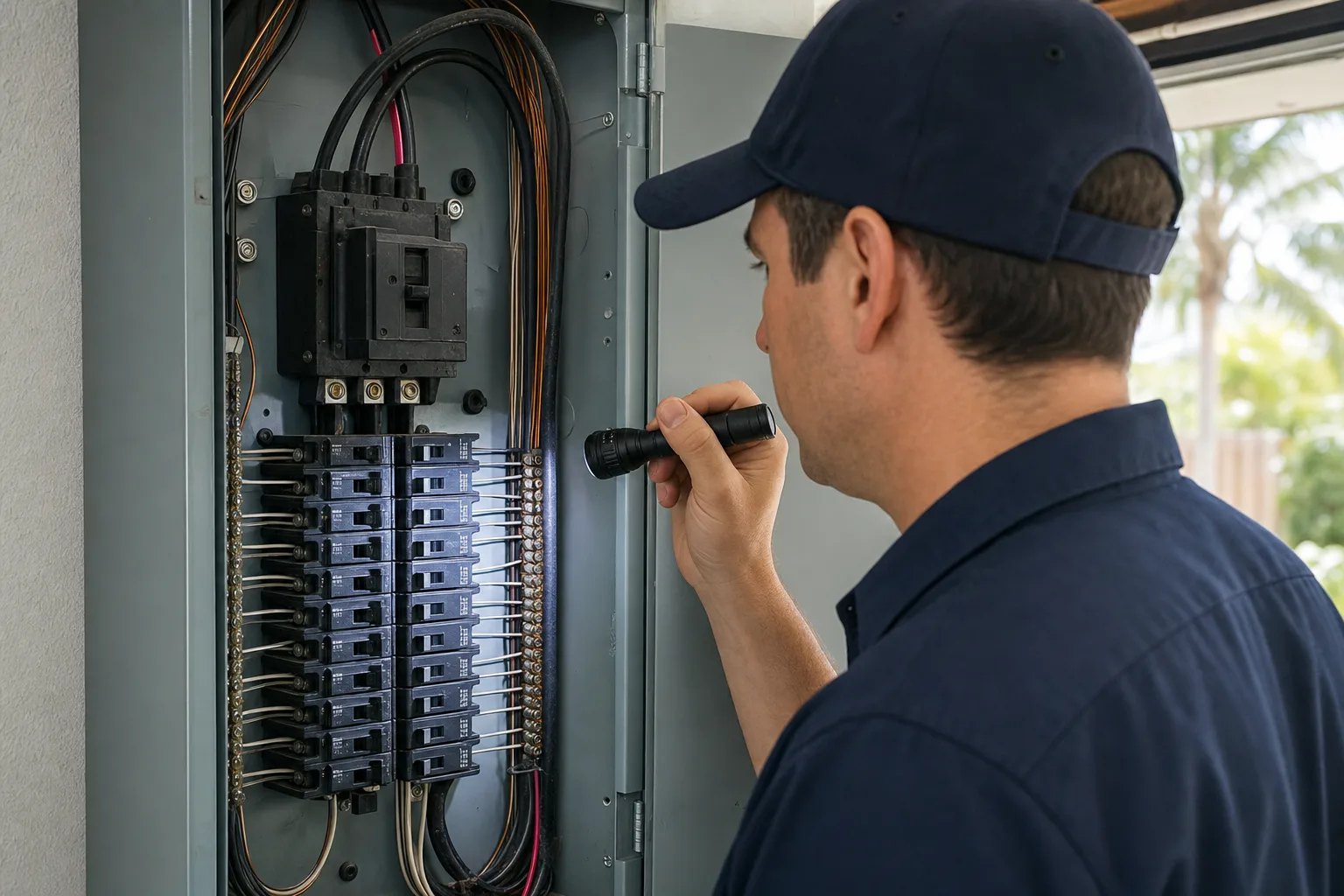
Titusville Main-Breaker FAQs and Your Next Diagnostic Step
Is it safe to reset my main breaker if it has tripped more than once?
Do not continue resetting it. Repeated trips indicate an unresolved condition, and restoring power can expose damaged equipment to current again. Leave the repeatedly tripping breaker off and obtain professional guidance. If there is smoke, active sparking, a burning odor, or water affecting equipment, stay away and follow emergency guidance instead.
Why does the main breaker trip when the AC and dryer run together, even though their breakers stay on?
The main sees the combined demand of the circuits it supplies. Individual appliance circuits can remain within their limits while total demand becomes too high. Connection heating or deteriorated equipment may produce a similar pattern, so that combination of appliances is a diagnostic clue—not proof that the service needs upgrading.
What if the main breaker trips when very little equipment is running?
“Little use” may exclude automatic loads such as a water heater, pool pump, refrigeration equipment, or an AC compressor. It can also point toward connection damage, breaker deterioration, or a fault. Report what you know was operating and what might cycle automatically. Do not assume light apparent demand makes another reset safe.
Can the main breaker be replaced without replacing the entire electrical panel?
Sometimes. The answer depends on the panel’s design, condition, approved replacement options, and whether heat or arcing damaged nearby components. A qualified electrician must determine compatibility and safe isolation requirements. Replacing a main breaker is not a DIY task, even with its handle in the off position.
What affects troubleshooting costs and repair timing in Titusville, and could the utility need to disconnect service?
Cost and timing depend on access, the complexity of the symptoms, the amount of testing needed, equipment condition, parts availability, and the repair scope. Condo electrical rooms, tenant scheduling, and shared service equipment can add coordination requirements.
Yes, utility disconnection may be necessary for work that cannot be safely isolated using the property’s existing equipment. Permit, inspection, and utility scheduling can influence when service is restored. Ask the contractor to explain the diagnostic charge, proposed repair scope, expected interruption, and any unresolved scheduling dependencies.
Get the cause diagnosed before choosing the replacement
If your main breaker keeps tripping in Titusville and there are no active emergency warning signs, call Deltron Electric at (833) 335-8766. Describe when it trips, which major appliances were running, whether the whole property lost power, and any warning signs you safely observed. Then schedule a troubleshooting visit to determine whether the appropriate next step is load management, a targeted repair, or a panel or service upgrade.
If there is smoke, fire, active arcing, or an immediate electrical hazard, keep away and seek emergency assistance rather than waiting for a routine service visit.